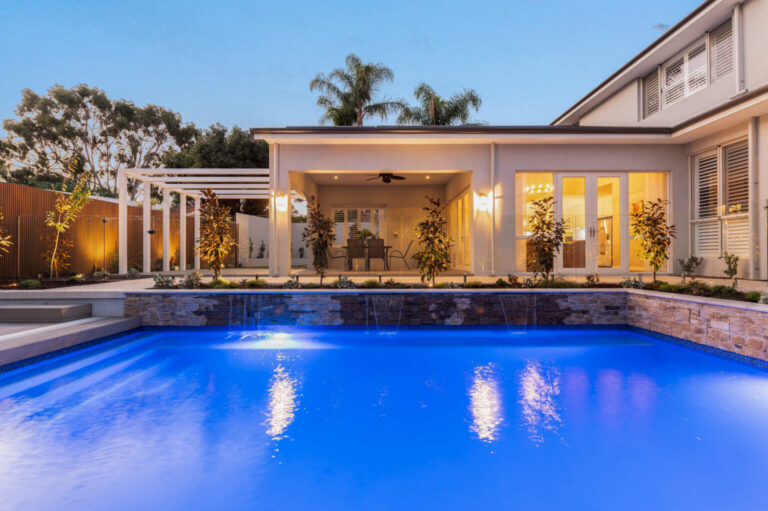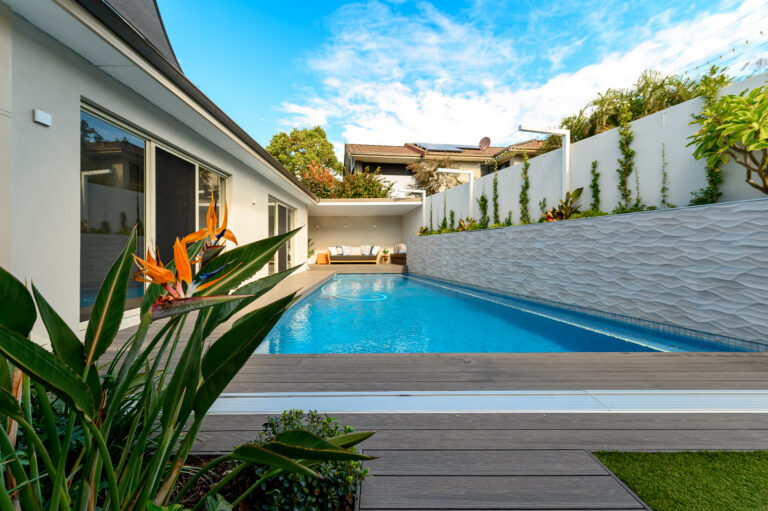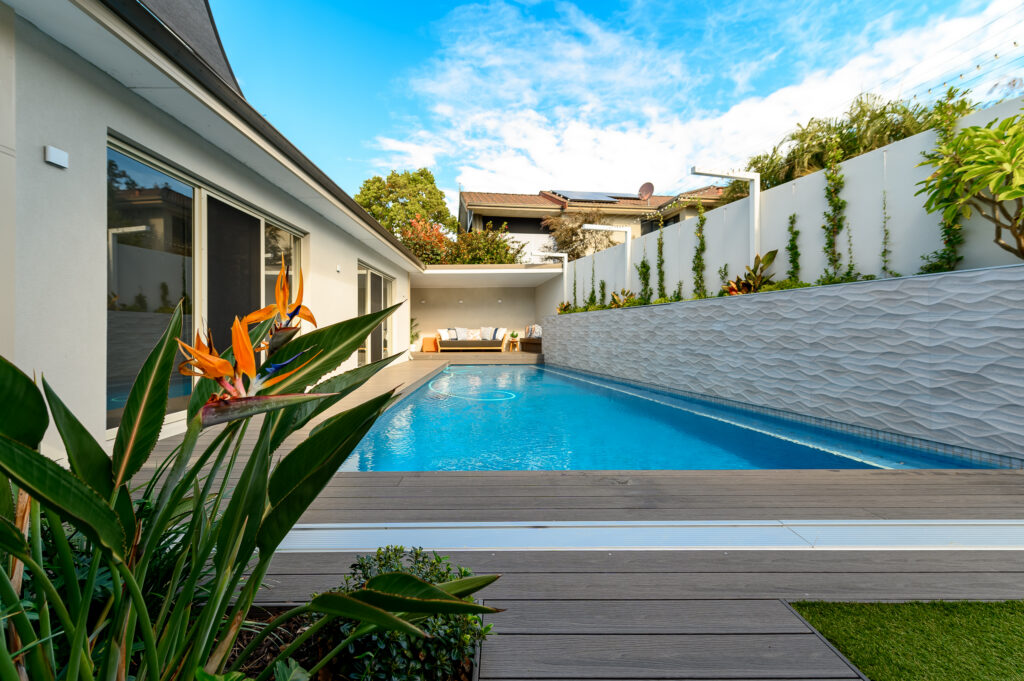
The quick version
- A pool zone subjects decking to constant moisture, pool chemicals and barefoot traffic in extreme heat.
- Composite decking resists moisture, rot, chlorine and salt without any oiling or sanding. Capped composite boards offer the best UV stability for Perth’s conditions. The trade-off is that composite can run hotter underfoot in direct summer sun.
- Timber decking delivers a natural look and stays cooler underfoot, but demands disciplined maintenance around a pool. Lapsed upkeep leads to splintering, greying, cupping and decay faster than on a standard deck.
- Slip resistance matters in every pool zone. Look for boards tested to a minimum P4 classification under AS 4586 and a Class B wet barefoot rating.
- Perth’s UV intensity, hot dry summers and coastal salt air all accelerate material degradation.
- The best choice depends on how your family uses the pool: daily swim families who want zero weekend maintenance tend to lean composite, while homeowners who love a natural timber look and are committed to the upkeep schedule tend to lean hardwood.
The decking that works beautifully on a back veranda or garden platform does not work for every decking project. This is a mistake homeowners often make when choosing pool decking in Perth.
A pool zone changes everything. The deck is wet for hours every day. Chlorinated water or salt splash sits on the surface, then dries, then sits again. Kids run across it barefoot in 38-degree heat. And in Perth, the UV exposure pummeling the surface from October through March is among the most intense anywhere in Australia.
So the question of composite decking vs timber around a pool is not really the same as composite vs timber for a general outdoor deck. The priorities shift. Moisture resistance, chemical durability, slip safety and heat underfoot all jump to the top of the list. The right answer depends on how your family uses the pool, and how much ongoing maintenance requirements you are willing to commit to.
Why a pool zone is different from the rest of the garden
A standard garden deck dries between rain events. It is typically walked on with shoes, and deals with nothing more aggressive than rainwater.
Decking around a pool is exposed to constant splash-out, standing water and localised humidity that never fully clears during swim season. This persistent moisture creates severe swelling and shrinking cycles in timber boards. When sub-deck ventilation is inadequate, the moisture imbalance causes cupping, tenting, and accelerated decay.
Chlorinated systems and saltwater chlorinators both deposit corrosive chemicals onto the deck surface with every splash. Within one metre of a swimming pool, all metal fasteners, connectors and brackets should be highly corrosion-resistant, typically stainless steel grade 316.
Unlike a general entertaining deck where guests wear shoes, a pool surround is designed specifically for barefoot traffic on a surface that may be wet, hot, or both.
Composite decking in a Perth pool zone
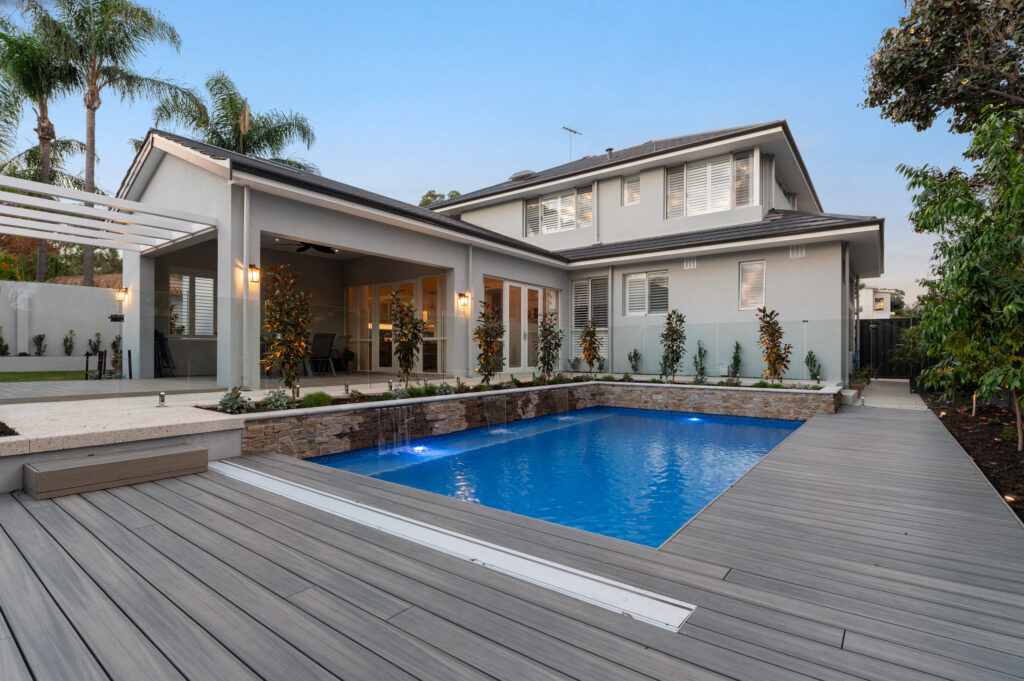
Composite decking boards are engineered from a blend of wood fibres and polymers, and this composition gives them several advantages in a wet, chemically exposed pool environment.
Moisture and chemical resistance
Composite boards resist moisture uptake. They do not swell, warp, or rot from constant pool splash. They also resist degradation from chlorine and salt, which means pool water landing on the surface does not break the material down the way it does with untreated or under-maintained timber.
For families running saltwater chlorinators, this resistance is particularly relevant. Salt systems deposit a fine saline residue that accelerates corrosion and timber deterioration over time.
Low maintenance for a high-splash environment
This is where composite decking earns its reputation as a low-maintenance decking option around pools. There is no oiling, staining, sanding, or resealing cycle. A hose-down and occasional scrub with soapy water is the extent of the routine.
Consistent texture and splinter-free safety
Over time, natural timber boards can crack, develop surface splits, and throw splinters. In a barefoot pool zone, that is a safety concern, particularly for younger children.
Composite boards do not splinter. Their manufactured surface texture remains consistent across the decking lifespan, which contributes to reliable slip-resistant decking performance in wet conditions. The surface profile stays uniform rather than degrading unevenly the way timber grain can when exposed to weather and chemicals.
Colour stability under WA sun: the case for capped composite
Perth receives approximately 8.8 hours of sunshine per day, and the UV index regularly exceeds 11 during summer. That level of UV exposure fades unprotected surfaces aggressively.
Standard composite boards include UV inhibitors that hold colour reasonably well compared to raw timber. But for pool zones in Perth, capped composite is the stronger choice. Capped composite boards feature a co-extruded polymer shell wrapped around the core, providing an additional layer of UV-stable decking protection along with enhanced resistance to staining, fading, and chemical exposure. In a WA coastal environment where salt air, chlorine, and UV all compound, that outer shell does meaningful work.
The issue of heat
Composite decking can absorb and retain more heat than some timbers in direct summer sun. On a 38-degree Perth afternoon with full sun exposure and no shade, dark-coloured composite boards can become uncomfortably hot underfoot.
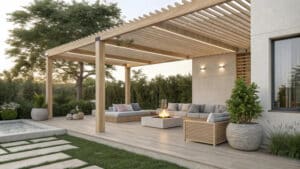
Lighter board colours reflect more heat, textured finishes help, and shade structures like a pergola, shade sail, or mature tree canopy over the pool zone make a significant difference.
Timber decking in a Perth pool zone
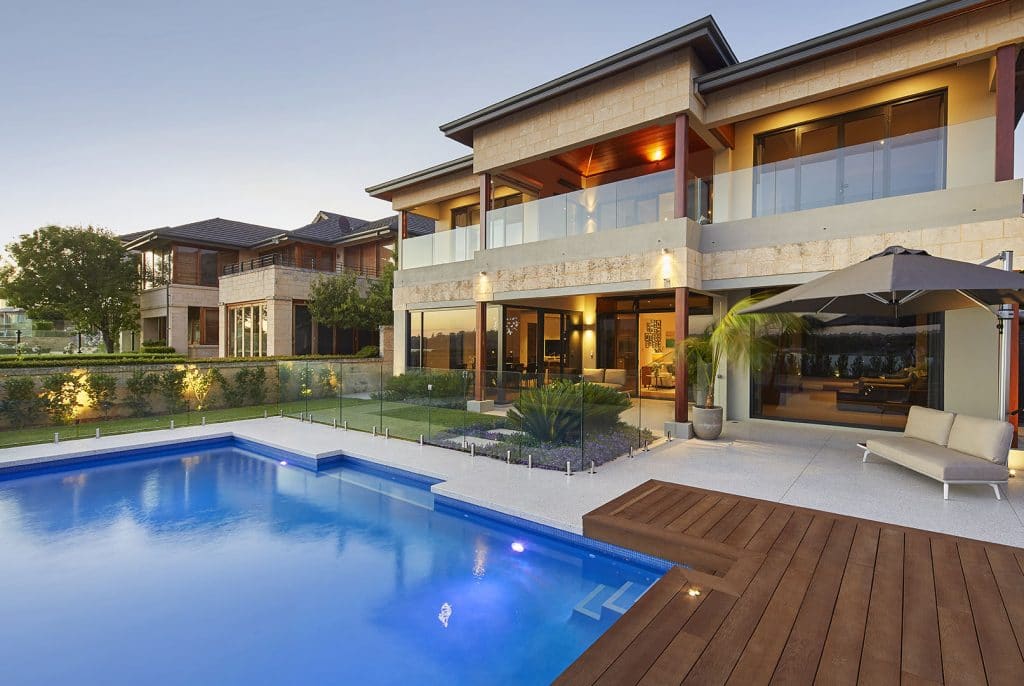
There is a reason timber remains a popular choice for decking materials in Perth. The natural warmth, grain character, and tactile feel of real hardwood are difficult to replicate. For homeowners who value that aesthetic, no composite finish quite matches it.
But around a pool, timber demands more from its owner.
The look and feel that draws people in
Jarrah, merbau, spotted gum, and blackbutt all deliver distinctive colour, texture, and warmth that connect an outdoor space to the natural landscape. Jarrah in particular is a Western Australian native hardwood with deep red tones and natural durability that has been a long-term staple of Perth decking. When freshly oiled and well maintained, a timber pool deck is undeniably beautiful.
Timber also tends to stay cooler underfoot than composite in direct sun, particularly lighter-coloured species or boards finished with a light-toned oil. For families concerned about surface temperature around the pool, this is an advantage.
The maintenance reality around a pool
Timber around a pool is not a “set and forget” material.
The WoodSolutions Technical Design Guide recommends coating decking boards on all four sides with a water-repellent preservative or oil-based primer before installation. Every cut and notch made during construction should be sealed immediately. Post-installation, penetrating decking oils need reapplication as frequently as every six to twelve months for solvent-based systems, with pigmented stains offering a slightly longer cycle of two to five years.
Around a pool, that schedule matters even more. The combination of constant splash-out, chemical exposure and Perth’s extreme UV means the protective coating degrades faster than it would on a sheltered veranda. Debris needs to be cleared from board gaps annually to maintain sub-deck ventilation. Plant pots should sit on elevated cleats or stands, never directly on the timber.
What happens when decking maintenance slips
If the upkeep cycle lapses, the consequences around a pool are swift and visible.
Unfinished or neglected timber loses its colour and weathers to a flat silver-grey. The wood dries out and develops surface cracking, which produces sharp splinters on a surface designed for bare feet. Boards constantly absorbing pool water without a protective finish will cup, warp or twist.
In the worst case, trapped moisture from swollen board gaps creates conditions for decay fungi. The structural integrity of the deck is then compromised. This is not a scare tactic. It is the documented change of under-maintained timber in high-moisture environments, and it happens faster under WA conditions.
Slip resistance and safety underfoot
For a family wanting a backyard pool, a common question asked is: which surface is safer for wet, bare feet?
In Australia, slip resistance is classified under AS 4586, the Australian Standard for pedestrian surface materials. The National Construction Code (NCC) mandates specific slip-resistance ratings for stairs, ramps and landings, but not for general pool decking. However, the companion handbook HB 198:2014 provides recommended minimum slip-resistant ratings for different environments. For wet barefoot pool surrounds, the guidance recommends a minimum P4 classification (pendulum test) and Class B (wet barefoot inclining platform test).
In practice, both composite and timber can achieve adequate slip resistance when specified correctly. Quality composite boards are manufactured with a textured surface profile designed to provide consistent grip when wet. Timber achieves traction through its natural grain and surface texture, though this can degrade over time as the finish wears, the surface weathers, and mould or algae build up in the grain. A freshly oiled, well-maintained timber deck offers good traction. A neglected one can become dangerously slick.
How Perth’s climate changes the calculation
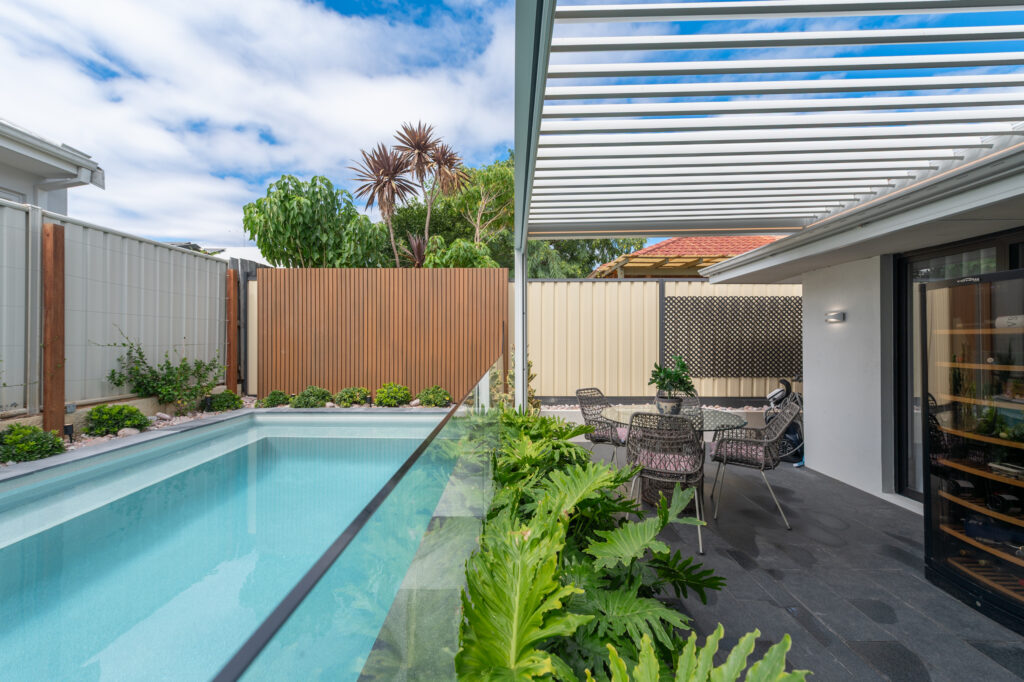
Generic decking comparison guides written for a national or international audience do not account for WA coastal conditions. Perth’s specific combination of environmental pressures changes the performance equation for both materials.
Average UV index maps show Perth’s summer UV regularly exceeding 11 on the index scale. At least two in three Australians will be diagnosed with skin cancer in their lifetime, and WA is among the highest-risk states. As well as affecting the skin, the UV degrades every outdoor surface, fading timber finishes and testing the UV inhibitors in composite boards season after season.
Perth’s Mediterranean climate delivers long stretches of consistent heat with very little summer rainfall. A pool deck in Scarborough or Joondalup can go weeks without a drop of rain from November to March. For timber, this means the protective oil or stain finish is under relentless UV without the humidity that helps slow surface degradation in eastern-state climates. For composite, it means surface temperature management (shade and colour selection) is not optional.
From Cottesloe to Hillarys, Rockingham to Mandurah, salt-laden air accelerates corrosion of fixings and the breakdown of unprotected surfaces. Timber decks in coastal suburbs need more frequent maintenance cycles. Composite decking, particularly capped boards, handles the salt exposure with less visible degradation, though fixings still need to be specified to marine-grade standards.
Which decking solution suits your family?
The decision is less about which material is “better” and more about which one matches how your family lives.
Choose composite if your family uses the pool daily, you want to spend weekends in the pool rather than maintaining the deck around it, you are drawn to a consistent, modern aesthetic, or you live in a coastal suburb where salt air compounds the maintenance burden. It is a strong fit for households prioritising a low-maintenance decking surface that handles moisture, chemicals and UV without an ongoing upkeep commitment.
Traditional timber decking may suit you better if you genuinely love the natural look and texture of real hardwood and that aesthetic is non-negotiable for you, you are realistic about the maintenance schedule and willing to follow it, or you want a surface that stays cooler underfoot in full sun, and you are not planning to add shade over the pool area. Jarrah and spotted gum in particular deliver a warmth and character that composite can’t fully match.
Some families land on a combination: composite in the high-splash zone immediately surrounding the pool, with timber on a connected entertaining deck further back where the chemical and moisture exposure is less severe. There is no single right answer to choosing the right material. There is only the right answer for your pool zone and your willingness to maintain it.
Ready to talk about your pool decking?
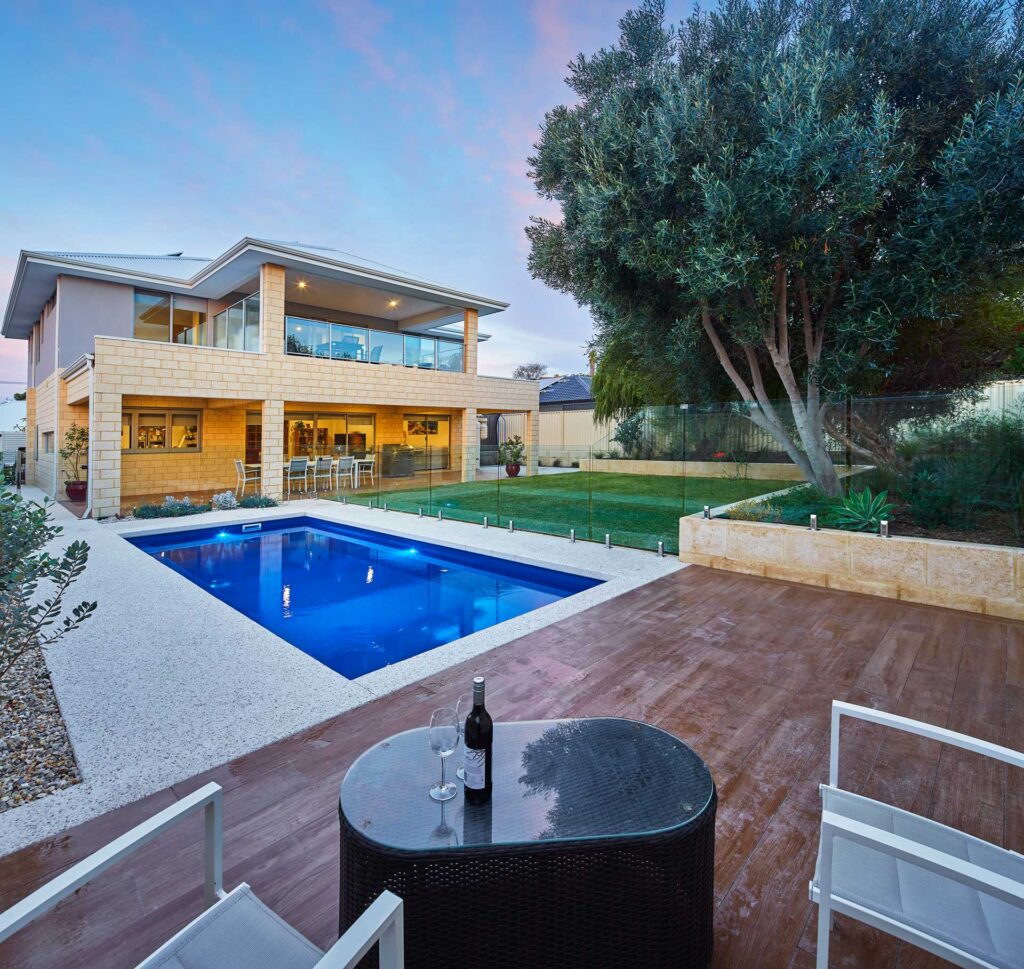
At Luke’s Landscaping, we design and build pool landscaping across Perth that is tailored to the site, the family and WA conditions. Asking yourself the question of composite decking vs timber, or curious about a combination of both, our team can walk you through the options with your specific pool zone in mind, from material selection and slip-rated surface finishes through to shade design and sub-deck ventilation.
We have been building outdoor spaces in Perth since 2008, and our team understands the specific demands of WA’s climate, soils and coastal conditions. Explore our decking services and past projects or start a conversation with us about your pool area.
Frequently asked questions
The two materials respond differently. Composite decking, particularly capped boards, resists chemical staining well because the polymer shell prevents absorption. You may see white salt residue from evaporated splash water, but it washes off with a hose. Timber is more vulnerable. Chlorine splash can bleach the surface unevenly, and salt systems deposit a corrosive residue that accelerates finish breakdown between oiling cycles. Keeping timber well-oiled creates a barrier against chemical absorption, but any lapse in that schedule leaves the surface exposed.
Quality capped composite decking commonly carries manufacturer warranties of 25 to 30 years and can last well beyond that with basic cleaning, since it does not rot, splinter or require protective recoating. Hardwood timber decking in a high-durability species (jarrah, spotted gum or merbau) can last 15 to 25 years or longer around a pool, but only with a consistent maintenance schedule. Timber that is left without protective finishes in a pool zone deteriorates significantly faster under Perth’s UV and heat.
More than most homeowners expect. A north-facing pool zone in Perth receives direct sun for most of the day during summer, which means surface temperatures run hotter and UV degrades finishes faster. Composite in a north-facing pool zone benefits from lighter colour selection and ideally shade cover. Timber handles direct heat better underfoot but will need more frequent re-oiling because the finish breaks down faster under sustained exposure. South-facing or well-shaded pool areas are more forgiving for both materials across the board.
With timber, individual board replacement is straightforward. A matching species and profile can be sourced, the damaged board removed and a new one fixed in place. The replacement will weather differently at first but typically blends in over a season or two. Composite boards can also be replaced individually, though colour-matching boards installed years earlier can be more difficult if the product range has changed or the existing boards have settled into their post-fade tone. Keeping a small number of spare boards from the original installation is a practical precaution with composite.