Here’s a quick summary
- Timber sleeper walls: Most accessible starting point, but shortest lifespan at 15–25 years. Best suited to low walls under 600mm.
- Concrete sleeper and panel-and-post walls: Versatile, low-maintenance and strong on reactive clay soils. Typically last 40–50+ years.
- Limestone block walls: The classic Perth retaining wall material. UV-stable, locally quarried and well-suited to sandy soils.
- Brick and masonry walls: Premium finish, typically chosen where the wall needs to match existing brickwork or achieve an architectural look.
- Wall height, soil type and drainage matter more than material choice alone.
- Any wall retaining more than 500mm of soil in WA requires a building permit.
If you’ve decided you need a retaining wall, you’ve already cleared the biggest hurdle. The slope needs managing, the soil is shifting, or the block needs levelling. That part’s settled.
Now comes the question that stalls most Perth homeowners: which material?
It’s not as simple as picking what looks best. Retaining wall materials perform differently depending on your wall height, your soil type, how accessible your block is and what the wall actually needs to do structurally. A material that works brilliantly on sandy coastal ground in City Beach could be the wrong call for reactive clay in Ellenbrook.
This guide compares the four most common retaining wall materials in Perth: timber sleepers, concrete sleepers, limestone blocks and brick. The goal is to help you narrow the field before your first conversation with a builder.
What actually determines the right material for your block
Choosing between retaining wall materials in Perth isn’t about personal preference alone. It’s shaped by a set of site-specific factors that narrow your options before aesthetics even enter the conversation.
Wall height sets the structural demands
Height is the single biggest variable in any retaining wall project, and it’s not a linear increase in complexity.
A wall under 600mm is a relatively simple structural proposition. Most materials handle it comfortably, and engineering certification isn’t typically required. Once the wall climbs past 600mm, the demands for structural support compound: deeper footings, more reinforcement, heavier materials and (in most cases) structural engineering certification under the Building Act 2011.
Past 1 metre, material choice and construction method need to align with the engineering requirements of the specific site. A 2-metre wall is a fundamentally different project to a low planter edge, regardless of which material you choose.
Your soil narrows the field
Perth’s soil varies dramatically across the metro area, and that variation genuinely affects which retaining wall materials will perform best on your block.
The coastal and central suburbs sit on the Bassendean and Spearwood dune systems: deep, free-draining sands that suit heavy materials like limestone. Further inland, the Guildford Formation (running through Midland, Bassendean, Bayswater and out towards Ellenbrook and Byford) presents reactive clay that expands when wet and shrinks when dry. That cyclical movement stresses anything sitting in or on the soil, which favours deep-anchored systems like concrete sleeper posts over gravity-based walls.
In the Perth Hills (Kalamunda, Mundaring, Darlington), laterite and “coffee rock” create harder-to-excavate ground that affects both material selection and construction method.
For properties on reactive clay, the choice between limestone and concrete retaining walls becomes especially significant.
Access and slope shape what’s practical
If a small excavator can drive straight to the wall location, most materials and methods are on the table. If materials need to be carried by hand through a narrow side passage, or the block slopes steeply, heavier products like limestone blocks become more labour-intensive to deliver and place.
On sloped blocks that need landscaping across multiple levels, the practical realities of access can genuinely influence which retaining wall material makes the most sense.
How Perth’s four main retaining wall materials compare
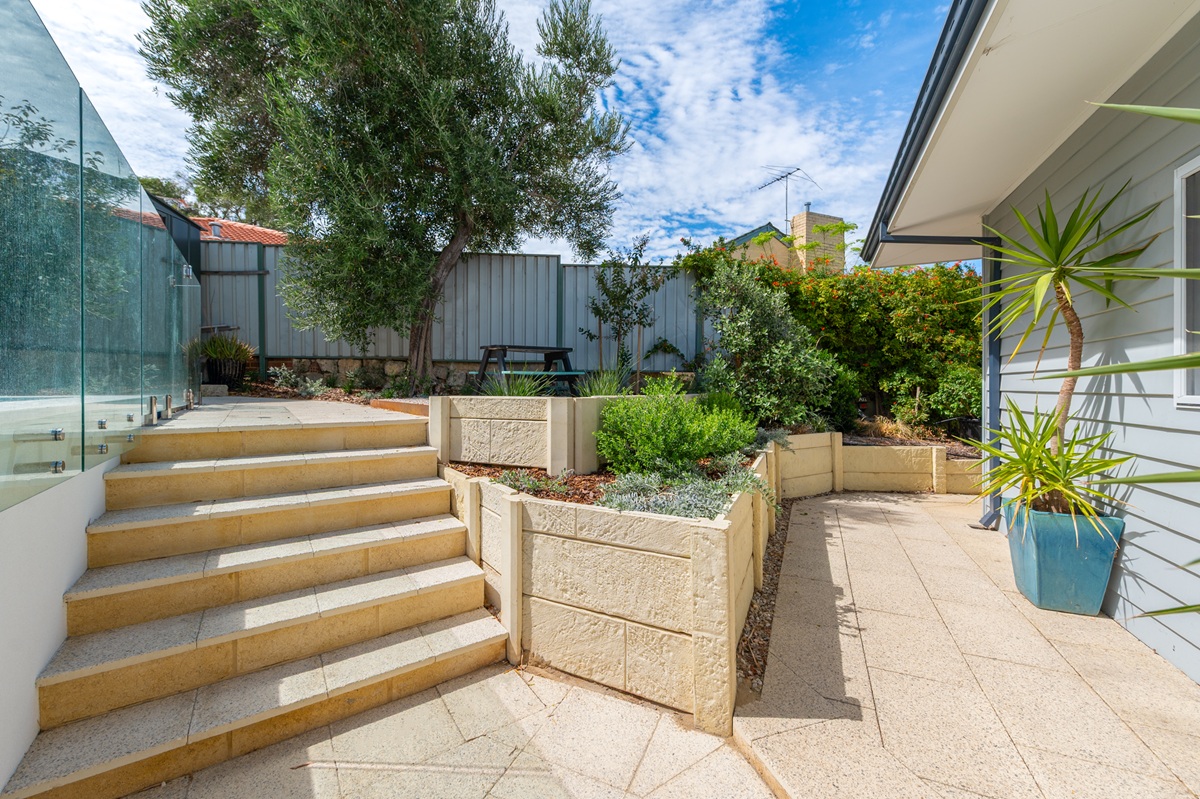
The most common types of retaining walls Perth homeowners choose from each bring different structural capabilities, lifespans and maintenance profiles. Here’s what each does well, where it falls short and which Perth conditions it suits best.
Timber sleeper walls
Timber sleepers are the most accessible entry point for a retaining wall. Treated pine needs a minimum H4 hazard class under AS 1604 for ground contact, with hardwood lasting longer but requiring a greater commitment upfront.
The trade-off is lifespan. In Perth’s climate, timber walls typically last 15 to 25 years before rot, warping or termite damage requires replacement. Perth sits within a moderate-to-high zone on CSIRO’s national termite hazard map, and even treated timber degrades faster here than in cooler, less UV-exposed climates.
For walls under 600mm in straightforward applications, timber is practical and performs the job. For anything taller or structural, concrete, limestone or brick is the better long-term choice.
Concrete sleeper and panel-and-post walls
Of all the retaining wall systems used in Perth, concrete sleeper panel-and-post is the most popular right now. Reinforced concrete panels slot between galvanised steel posts set into concrete footings, creating a wall that resists rot, fire and termites and typically lasts 40 to 50 years.
Modern sleepers come in finishes including smooth, textured, timber-grain and stone profiles in colours like charcoal, sandstone and light grey. They suit contemporary builds where clean lines are part of the design intent.
The structural advantage is in the post-and-footing system. Steel posts anchor deep into the ground, which makes concrete sleepers particularly well-suited to reactive clay soils where seasonal ground movement would stress a gravity-based wall. Installation is also faster than limestone, with no mortar joints and no curing time required.
Limestone block walls
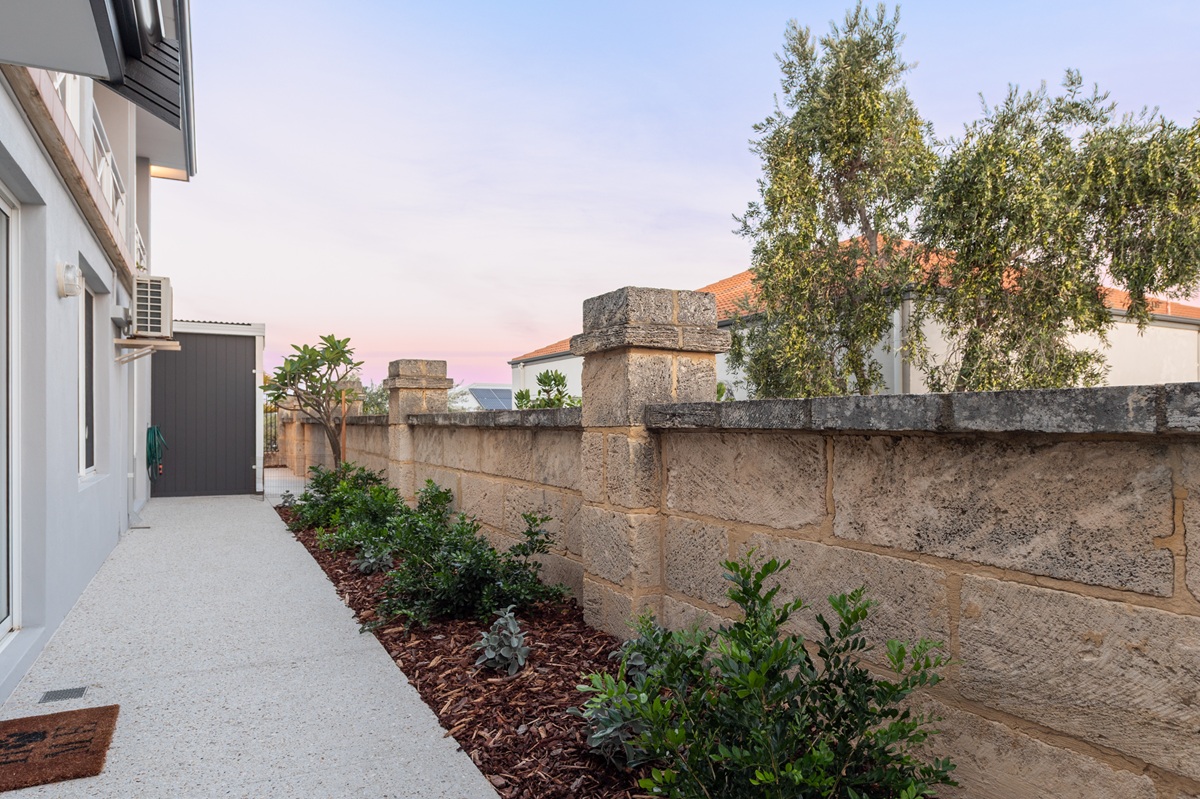
Limestone is the quintessential Perth retaining wall material. The raw material, Tamala Limestone, is a calcarenite formation that has been quarried along the WA coastline for generations. It handles UV exposure and coastal salt air well and carries a warm, natural aesthetic that suits the Perth streetscape.
Reconstituted limestone blocks (crushed limestone blended with cement) offer more consistent dimensions and higher structural capacity than natural quarried blocks. Standard blocks are 350mm x 350mm x 1000mm, and their weight is the key structural feature.
A limestone wall works as a gravity structure. The mass of the blocks holds back the soil, with no steel framework involved. That weight-based approach pairs well with Perth’s sandy coastal soils: heavy blocks on compacted sand create a naturally stable structure. For walls up to about 1 metre, it’s a straightforward, proven system. Above that, engineering certification is required, but limestone gravity walls are commonly built to 1.8 metres and beyond.
Perth homeowners tend to view the natural weathering of limestone as a feature rather than a flaw.
Brick and masonry retaining walls
Brick retaining walls (clay brick, concrete blockwork or rendered masonry) sit at the premium end of retaining wall materials in Perth. They’re typically chosen where the wall needs to match existing brickwork on the house or where a rendered, painted finish is part of the design intent.
Structurally, they’re extremely durable. But they’re also the most labour-intensive to construct, requiring experienced bricklayers and mortar curing time. For boundary walls where visual finish is secondary, concrete sleepers are often the more cost-effective choice for a comparable structural result. For visible, street-facing walls where aesthetics are the priority, brick remains a strong choice.
The factor that matters more than your material choice
Pick the wrong material, and you’ll be frustrated with the result. Skip the drainage, and you’ll be rebuilding.
Every retaining wall in Perth needs an agricultural drainage system behind it: a perforated pipe wrapped in geotextile fabric, bedded in gravel, running the full length of the wall. Without it, water builds behind the wall after rain, creating hydrostatic pressure that causes walls to bow, crack and eventually collapse.
Poor drainage is the single most common reason retaining walls fail in Perth. It doesn’t matter whether the wall is timber, concrete, limestone or brick. And it doesn’t matter how well the wall was built. If the water has nowhere to go, the wall is on borrowed time. A closer look at how retaining walls prevent soil erosion in Perth shows just how critical proper drainage and structural design are to long-term performance.
If you’re comparing proposals and one doesn’t include drainage in the scope, that’s not a saving. It’s a warning sign.
Permits and engineering in WA
In Western Australia, most councils require a building permit for any retaining wall that retains more than 500mm of soil. Tiered walls are assessed on their combined total height, not each tier individually. These requirements sit under the Building Act 2011.
Structural engineering certification is typically required alongside the permit. An engineer will design the wall to suit your specific site conditions, retained height and any surcharge loads above it (driveways, structures, neighbouring fences).
Understanding council approval requirements for outdoor renovations in WA early is worth doing, because it affects your timeline, your material choice and your wall design.
When a DIY retaining wall is realistic
For a simple wall under 500mm, in a standalone position away from boundaries and structures, DIY is a viable option if you’re confident with the work. Concrete panel-and-post systems at that height are achievable for competent DIYers. Limestone, by contrast, requires skilled blocklaying even at lower heights.
But the moment the wall goes over 500mm, engineering certification and a building permit become legal requirements. And the consequences of getting it wrong are serious: a failed retaining wall can damage neighbouring property, undermine structures and leave you personally liable. Most failures trace back to inadequate drainage or missing engineering input, and they tend to emerge after a couple of winters once water pressure has done its work.
For any wall over 500mm, near a boundary or supporting a surcharge load, professional retaining wall design and construction is the smarter path.
Start with a site-specific conversation
Online comparison guides (this one included) are useful for narrowing the field. But retaining wall materials in Perth perform so differently from site to site that the right answer always comes back to your specific block — your soil, your slope, your setbacks and what you want the space to do.
Luke’s Landscaping has been designing and building retaining walls across Perth since 2008, from sandy coastal blocks to reactive clay in the east and steep hill terrain. You can see examples across the project portfolio. Every wall is site-specific, properly drained and structurally engineered where required, backed by 200+ five-star Google reviews and memberships with Irrigation Australia and the Landscape Industries Association WA.
A landscape design consultation covers everything from initial site assessment through to construction and handover. If you’ve got a retaining wall project on the horizon, the most useful step you can take right now is to get specific advice for your site.
Frequently asked questions
What’s the best retaining wall material for sandy soil in Perth?
Limestone block walls perform particularly well on Perth’s sandy coastal and central soils. Their weight creates natural stability as a gravity structure, and locally quarried limestone handles the UV exposure and salt air well. Concrete sleepers also work on sandy ground, though their real structural advantage is on reactive clay where deep-anchored steel posts resist seasonal ground movement better than a gravity wall can.
Do I need a building permit for a retaining wall in WA?
In most cases, yes. Under the Building Act 2011, any retaining wall that retains 500mm or more of soil requires a building permit. This includes tiered walls where the combined retained height exceeds 500mm. Structural engineering certification is also typically required, and development approval may be needed for walls near boundaries or front setbacks. Check with your local council early in the planning process.
Which retaining wall material lasts longest in Perth?
Concrete sleeper walls and well-built limestone gravity walls can both last 50 years or more when properly designed, drained and maintained. Brick and masonry walls are similarly durable. Timber sleeper walls have the shortest lifespan at 15 to 25 years in Perth’s climate. Across all materials, the factors that shorten a wall’s life are poor drainage, inadequate footings and missing engineering where it was needed. Construction quality matters more than material choice.
Can I build a retaining wall myself in Perth?
For walls under 500mm that aren’t near a boundary and don’t support any load above them, DIY is realistic. Concrete panel-and-post systems are the most accessible option for competent DIYers at low heights. Once the wall exceeds 500mm, a building permit and engineering certification are legally required, which means professional involvement becomes necessary.
How do I know which retaining wall material suits my block?
When comparing retaining wall materials in Perth, start with the three biggest site variables: wall height, soil type and access. Sandy coastal blocks suit limestone’s weight-based gravity system. Reactive clay inland favours concrete sleeper posts anchored through the moving layer. For walls under 600mm, most materials work well. For anything taller, the material needs to align with the engineering requirements of your specific site. A site visit from an experienced landscaper is the most reliable way to match the right material to your conditions.