The quick version
- Start with structure: Retaining walls are the skeleton of every sloped backyard. Get the materials, height, and drainage right, and every other element follows.
- Terracing creates usable land: A slope isn’t lost space. The right terracing transforms a gradient into multiple flat, functional outdoor zones.
- Drainage is non-negotiable in Perth: Sandy soils become water-repellent after summer, then get hit by intense winter rain. Without proper drainage solutions, that combination causes erosion, pooling, and wall failure.
- Plants do structural work: Native ground covers with deep fibrous root systems are among the most cost-effective erosion control tools available, and they look extraordinary doing it.
- Decking was made for slopes: An elevated timber or composite deck can turn a difficult gradient into a property’s most striking feature.
- Access matters more than people think: Safe, compliant steps and pathways on a sloped yard improve daily liveability dramatically-and are often designed as an afterthought.
- The slope itself can become the design: Split-level outdoor living spaces, sunken fire pit zones, and cascading water features all begin with a block most buyers would overlook.
Most Perth homeowners with a sloped backyard think they’ve drawn the short straw. They look at the drop, the bare sandy soil washing away at the edges, the water pooling in places it shouldn’t, and they think: this is a problem block. What they don’t realise-not yet-is that the slope is the most interesting thing about their property. Given the right design, it becomes the feature. The terracing. The elevated deck. The layered garden makes their backyard look like it was carved from the landscape rather than dumped on top of it.
But getting there is not an accident. It requires a genuine understanding of what’s happening below the surface, how Perth’s climate interacts with a sloped yard specifically, and which solutions actually hold up over the years rather than seasons. Sloped blocks in Perth fail-walls crack, soil washes out, drainage goes wrong-almost exclusively because of decisions made early in the design process.
Here’s what to know before any of that happens.
1. Retaining walls: the structural foundation of every sloped backyard
Every conversation about backyard landscaping ideas for sloped yards starts here. Without retaining walls, everything else is temporary. The soil moves, the slope reasserts itself, and whatever was built on top of it goes with it.
What most homeowners don’t know: The material choice isn’t primarily aesthetic. It’s structural. Perth’s sandy Bassendean soils-found under most of the metro area-are known for their low cohesion and shifting behaviour when wet. When they get wet after a long, dry summer, they don’t bond. They shift. A retaining wall in Perth isn’t just holding back dirt. It’s holding back a material with almost no internal friction to begin with.
Limestone is the dominant choice in Perth-locally quarried in WA, affordable, UV-stable, coastal salt resistant, and heavy enough to act as its own footing in many applications. For a cleaner contemporary look, concrete sleepers perform excellently and suit modern garden design schemes. Gabion walls (rock-filled wire cages) suit bushland settings and are inherently permeable, dramatically reducing the pressure that builds behind less forgiving materials.
Speaking of which: drainage behind every retaining wall is not optional. An agricultural drain-a perforated pipe wrapped in geotextile fabric, bedded in gravel-must run behind the full wall length. Without it, water pressure builds in the soil, and that’s what causes walls to bow, crack, and eventually fail. It’s the most common retaining wall failure in Perth. It’s entirely preventable.
In WA, any wall holding back more than 500mm of soil requires a building permit under the Building Regulations 2012, and typically structural engineering certification. This stops walls from collapsing onto neighbouring properties. If you’re weighing up materials and structural approaches for your specific site, our guide to retaining walls in Perth covers the full range of options.
2. Terracing: turning a gradient into outdoor rooms
Here’s the idea that changes everything: stop thinking about your sloped yard as a problem to be solved and start thinking about it as an opportunity to create multiple distinct outdoor zones, each at a different elevation, each with a different purpose. Entertaining on the upper tier. Gardens in the middle. Lawn or play space below. Connected by steps, defined by walls, unified by design.
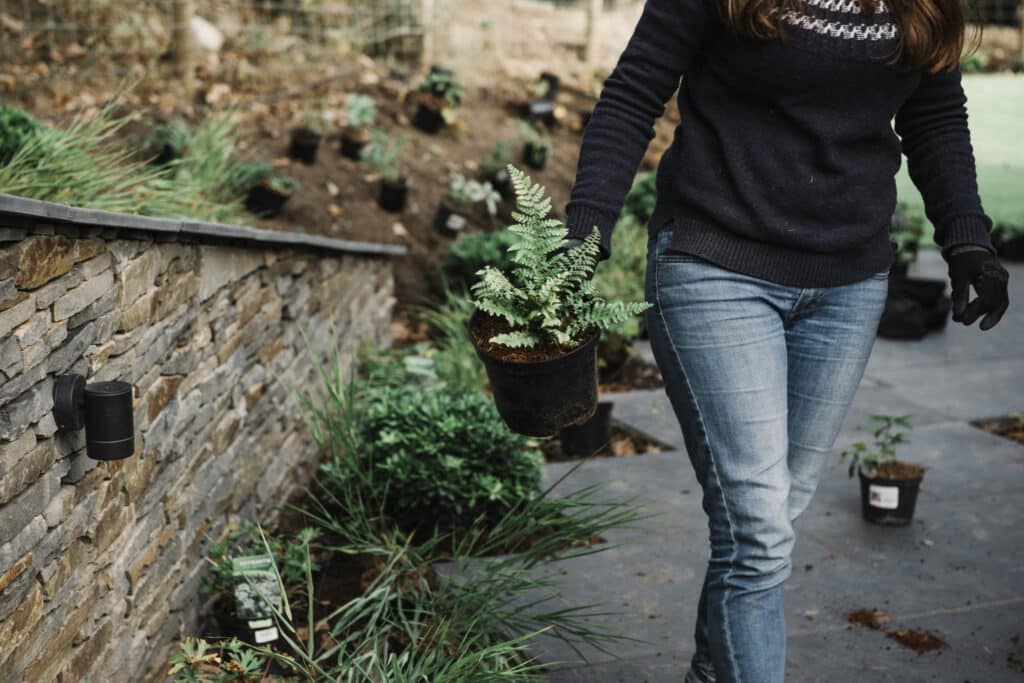
Structurally, terracing breaks a continuous slope into stepped flat platforms, each retained at the front edge. Build from the lowest wall upward, compact each level thoroughly-sandy soils require it-and integrate drainage at every tier.
One principle most homeowners learn too late: it’s always better to build more walls at lower heights than fewer walls at greater heights. A series of smaller limestone walls stepping up a steep slope is structurally simpler, more affordable, and more visually interesting than a single towering wall doing all the work.
What terracing does to a sloping garden is remarkable. It creates usable space, vertical interest, and a landscape that reads as three-dimensional. On a well-designed terraced block, the backyard stops feeling like a liability and starts feeling like the reason you bought the property. Well-designed retaining and terracing can increase usable space and improve overall appeal.
3. Drainage solutions: Perth’s most underestimated slope problem
Here’s something that will change how you think about the whole project. Perth’s sandy soils are hydrophobic. After the long, dry summer, the soil doesn’t just dry out, it becomes water-repellent. CSIRO research confirms that Perth’s sands develop water-repellent coatings around individual soil particles, making them some of the most hydrophobic soils in the world.
So when the first heavy winter rain arrives in June, it hits soil that actively repels it. Water sheets across the surface, moves fast downhill, picks up soil particles, and either ponds at the base of the slope or disappears into the neighbour’s yard. This is common across many sloped Perth properties. It’s not bad luck. It’s physics.
Solving it requires a system. Soakwells are Perth’s primary drainage solution and are legally required. WA regulations oblige homeowners to contain stormwater within property boundaries rather than redirecting it to adjoining land. On a sloped block, they’re positioned at the base where water accumulates and connected to surface collection points by an underground pipe. Aco drains at patio edges intercept surface water early. Agricultural drains behind retaining walls relieve hydrostatic pressure. Swales between terraces slow water and encourage infiltration rather than runoff.
Get drainage right, and every other landscaping solution on this list performs better and lasts longer. Poor drainage significantly increases the risk of premature failure.
4. Plant selection for erosion control: the science is surprising
There’s a quiet revolution happening in Perth’s sloping garden design. Homeowners are discovering that WA’s native plants, the ones that evolved for sandy soils, dry summers, and periodic flooding, are more effective erosion-control tools than most engineered solutions. And they look better doing it.
The data behind smart plant selection is striking. Ozbreed research measuring soil-strengthening capacity found that Lomandra longifolia cultivars increase soil shear strength by 250–370% compared to bare soil. Dianella ‘King Alfred’ achieves 752%. These aren’t decorative additions to a slope. They’re structural interventions.
For Perth slopes specifically, Myoporum parvifolium (Creeping Boobialla) is fast-spreading, virtually drought-proof once established, and forms a dense mat that prevents both water erosion and weed invasion. Ficinia nodosa (Knobby Club Rush) binds sandy coastal soils extremely effectively. Grevillea ground cover forms, ‘Bronze Rambler’ and ‘Gaudichaudii’, spread aggressively and are essentially maintenance-free. Combined with a rock garden approach-planting around natural or placed boulders-these species create a landscape that is both structural and beautiful.
For bare soil between new plantings, coir matting or jute mesh protects the surface through the first winter while root systems establish. Considered plant selection at this stage saves significant money on erosion repairs later, and if you want to explore what works best for your specific slope, our guides to Australian native plants for Perth gardens and landscape design are a good place to start.
5. Elevated decking: the steep slope’s best feature
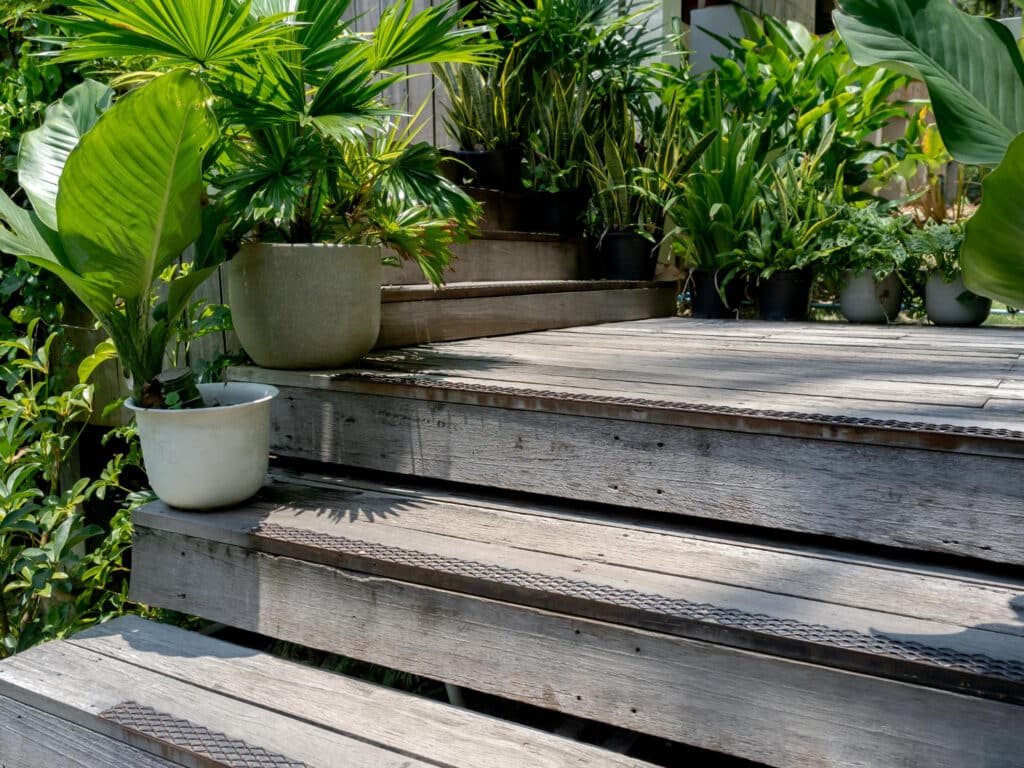
Slopes and decks have an almost perfect relationship, and it’s worth understanding why. On a flat block, creating an elevated outdoor platform requires significant excavation and concrete work. On a sloped block, the grade provides that height differential naturally. Concrete piers drilled into stable ground at varying depths accommodate the slope, posts are cut to different heights, and the deck surface sits level above a landscaped slope below. The visual effect is among the most dramatic transformations possible on a difficult block.
Timber remains the premium choice for Perth decks. Jarrah is the iconic WA hardwood-Class 1 durability, naturally durable and termite-resistant, beautiful colour-though it requires annual oiling in Perth’s intense UV conditions. Composite decking has become mainstream in Perth’s coastal and hills suburbs for practical reasons: no warping, no cracking, no termites, no oiling required, and modern products offer anti-slip finishes that are non-negotiable on an elevated deck where wet-weather safety matters.
For steeper slopes, multi-level decking, two or three platforms at different heights connected by short stair flights, creates distinct outdoor rooms at different elevations. Dining up top, lounging mid-level, garden below. The whole structure reads as an architectural response to the landscape rather than something placed on top of it. We cover the full range of timber and composite materials on our decking page, including what performs best at different elevations and exposures in Perth.
6. Steps, pathways, and rock gardens: access and aesthetics together
Steps get added last and budgeted last. They shouldn’t be. Safe, considered access on a sloped yard is the difference between a backyard used every day and one visited only when someone is motivated enough to navigate it carefully.
Australian Standard AS 4586 requires outdoor stairs in wet-exposed conditions to achieve a minimum P4 or P5 slip resistance rating. Risers must be uniform within 5mm. Handrails are required on longer or steeper flights. These are minimums, not aspirational targets.
Material choices matter. Broom-finished concrete provides a reliable grip. Exposed aggregate improves on that visually and texturally. Natural limestone treads suit a sloping garden using limestone retaining walls—same palette, unified result. Timber sleeper steps with gravel infill feel naturalistic in a bushland setting.
Beyond the practical, steps are a design opportunity. Wide, generous treads at shallow gradients feel leisurely. Curved stairways winding around a planted rock garden are sculptural. A rock garden built into the slope alongside the stair run solves access, erosion, and aesthetics simultaneously. It’s one of the most cost-effective landscaping ideas for a sloped yard when the budget is a constraint. For the horizontal surfaces that connect each level, our paving options range from exposed aggregate to natural limestone and porcelain.
LED lighting integrated into the base of step risers completes it, a pathway that feels considered at 9pm as much as 9am.
7. Split-level outdoor living: where the slope becomes the design
This is the backyard landscaping idea for sloped yards that most people don’t discover until they see someone else’s finished version and immediately wish they’d thought of it sooner.
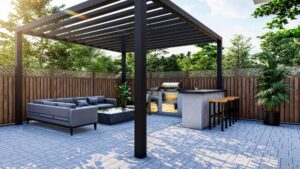
Every slope creates natural level changes. Those level changes, instead of being engineered away, can be designed around to create outdoor spaces richer and more interesting than anything possible on a flat block. Upper level: a covered patio or pergola that connects directly to the house. Mid-level: open lawn, garden, or play space. Lower: fire pit zone, vegetable garden, or a sunken seating area sheltered from the prevailing wind.
The retaining walls between levels do more than hold the ground. Capped with timber, they become bench seating. Planted with trailing natives, they become living green walls. Lit with LED uplights, they define the space after dark.
There’s also something worth considering about Perth’s climate here. A tiered, south-facing steep slope catches afternoon shade earlier, which is incredibly valuable from October through March. A north-facing sloping garden gets more winter sun on its lower terraces, making them warm and usable well into the cooler months. The slope itself becomes a passive climate tool once you stop fighting it.
The sunken variation-where a small zone is excavated into the slope-creates a sheltered, wind-protected social space impossible to replicate on a flat block without expensive construction. A sunken fire pit, surrounded by limestone walls and planted with soft native grasses, is arguably the most dramatic thing you can do with a challenging Perth block. Ourportfolio shows how these ideas have come together across completed Perth projects, if you want a sense of what’s possible.
The question worth sitting with
Most people with a sloped backyard spend years doing nothing. The complexity feels overwhelming. What the best backyard landscaping ideas for sloped yards have in common is a different starting point entirely: they don’t try to eliminate the slope. They work with it. Terracing follows the natural grade. Walls use local materials. Planting reflects the WA landscape. The deck sits above rather than against the slope.
The result is a backyard that feels inevitable-as if it could only have been designed for that exact site. That’s the goal. And it’s more achievable than it looks from the bottom of the slope.
Ready to transform your sloped backyard?

At Luke’s Landscaping, we design and build landscaping solutions for sloped yards across Perth-from gentle suburban grades in the northern corridors to steep, rocky blocks. We understand Perth’s soils, drainage requirements, council regulations, and climate. Every solution is site-specific, structurally engineered where required, and built to last.
Explore our full range of landscaping services, or get in touch with our friendly team to start the conversation.
Frequently asked questions
Yes, in most cases. Any wall holding back more than 500mm of ground requires a building permit under the Building Regulations 2012 and typically structural engineering certification. Even walls under 500mm may require approval if they affect adjoining drainage. Confirm with your local council before starting.
Limestone is the most popular choice-locally quarried, cost-effective, and well-suited to WA’s aesthetic. Reconstituted limestone blocks are the strongest form. Concrete sleepers perform excellently for larger retained heights. Timber sleepers are cheaper but have limited lifespans in Perth’s climate. In all cases, ag drainage behind the wall is essential.
A layered approach works best. Retaining walls and terracing interrupt the slope structurally. Soakwells and ag pipes manage stormwater within your property. Dense native ground covers-Lomandra, Myoporum parvifolium, Grevillea ground cover forms-bind soil with fibrous root systems, have been shown to significantly increase soil shear strength compared to bare soil. On freshly planted areas, coir matting or jute mesh protects the surface until plants establish.
Absolutely, and sloped blocks often produce more interesting outdoor spaces than flat ones. The most common approach is a level platform created by a retaining wall and compacted fill, then paved or decked. Split-level designs on steep slopes create distinct outdoor zones at different elevations. Elevated decking is particularly well-suited, as the natural grade provides the height differential a flat block would need expensive construction to achieve.