The quick version
- Both limestone and concrete sleeper walls can last 50+ years when built properly. Neither is a bad choice.
- Limestone suits traditional Perth aesthetics, performs well on sandy soils and works as a gravity wall system for taller applications.
- Concrete sleepers offer clean modern lines, are often more affordable to install and perform better in reactive clay soils.
- Perth’s soil varies dramatically by suburb, and your soil type genuinely affects which material will perform best on your block.
- Indicative 2026 installed costs: limestone ~$450–$650/m²; concrete sleepers ~$400–$700/m².
- Any wall retaining more than 500mm of soil in WA requires a building permit.
If you’ve decided you need a retaining wall, you’ve already done the hard part. You know the slope needs managing, the soil is moving, or the block needs levelling.
Now comes the question that stalls most Perth homeowners: limestone or concrete?
Both materials are used across thousands of Perth properties. Both last for decades. Both fail when done badly. The right choice comes down to your specific site, your soil, your slope, your suburb and your investment. A wall that’s perfect for a sandy coastal block in City Beach could be the wrong call for reactive clay in Ellenbrook.
When it comes to limestone vs concrete retaining walls, Perth conditions make the choice more personal than most online guides suggest. Whether you’re still weighing up retaining wall ideas or ready to commit, here’s how both materials actually perform, what each costs and where each has a genuine edge.
What “limestone” actually means in Perth retaining walls
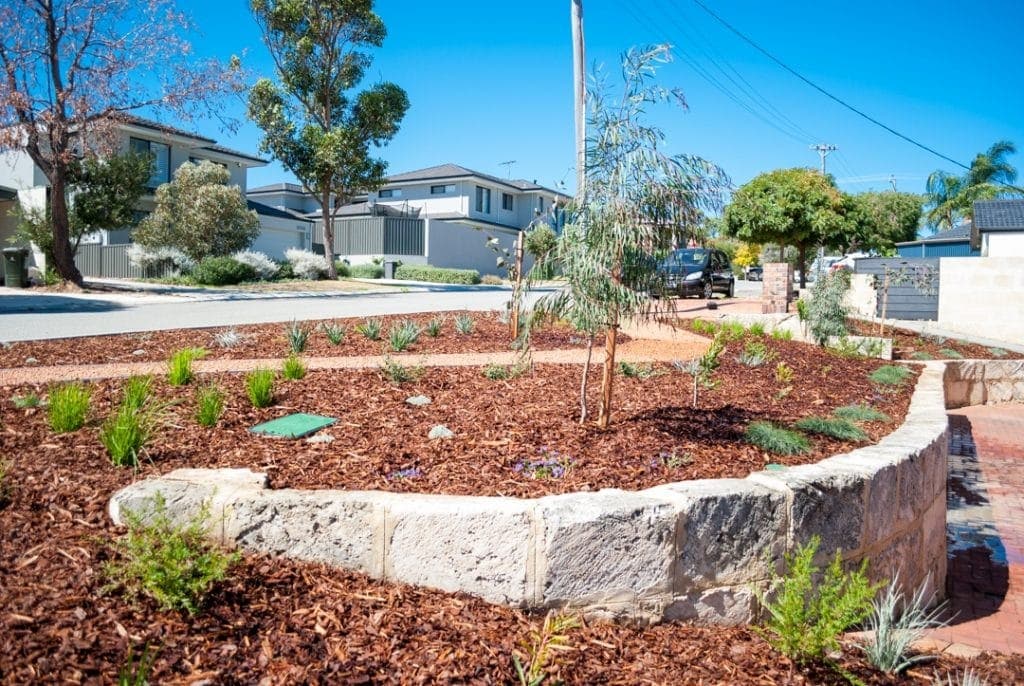
When Perth homeowners say “limestone retaining wall,” they almost always mean reconstituted limestone blocks. These are manufactured blocks made from crushed limestone blended with cement, not natural stone cut straight from the ground.
The raw material, Tamala Limestone, is a calcarenite formation that’s been quarried along the WA coastline for generations. Its warm, cream-toned appearance is part of Perth’s built identity. For retaining walls, Main Roads Western Australia’s Specification 905 sets a minimum compressive strength of 5 MPa for standard blocks and 7 MPa for wet or marine environments.
Standard block size is 350mm x 350mm x 1000mm. They’re heavy. That weight is the whole point.
A limestone block retaining wall works as a gravity structure. The mass of the blocks holds back the soil, with no steel framework involved. The blocks are stacked, mortared and backed with drainage. For walls up to about 1,000mm, it’s a simple, proven system. Above that, engineering certification is required, but limestone gravity walls are commonly built to 1,800mm and beyond.
That weight-based approach is why limestone pairs so well with Perth’s sandy soils. Heavy blocks on compacted sand create a naturally stable structure, whether you’re building full-height retaining walls or lower garden walls.
What concrete sleepers bring to a retaining wall
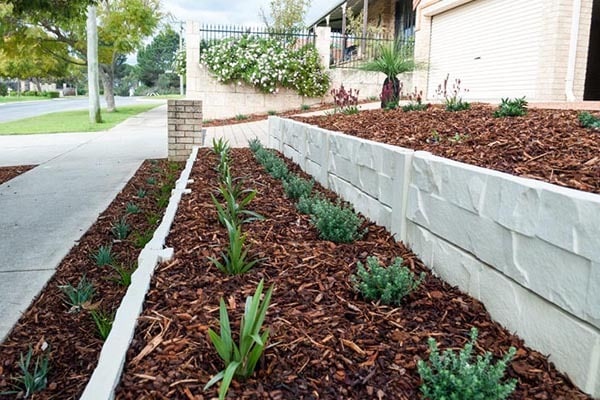
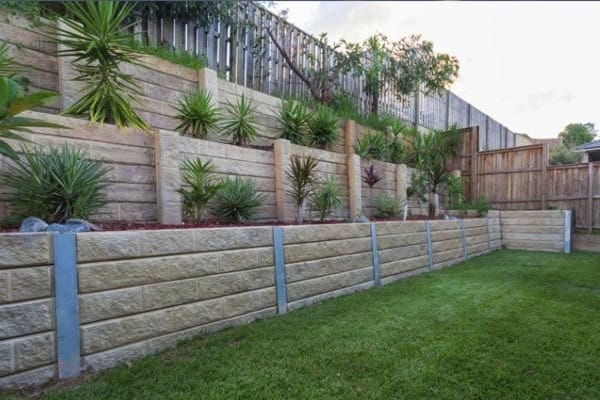
If limestone is Perth’s old faithful, concrete sleepers are the modern alternative, gaining serious ground. Unlike stacked concrete retaining wall blocks, this retaining wall system uses a panel-and-post approach: precast reinforced concrete panels slot into galvanised steel posts set deep into concrete footings.
Quality sleepers are manufactured with 40–60 MPa concrete and reinforced with steel bars, built to Australian Standard AS 3600:2018 (50-year design life). On the surface, you get a clean, uniform wall face. Modern sleepers come in finishes including smooth, timber-grain, stone texture, charcoal and sandstone. They suit contemporary builds where clean lines are the brief.
The practical advantages stack up quickly. No mortar joints means no repointing later. Concrete is impervious to termites and rot. Installation is faster than limestone. And for low walls on stable, accessible sites, the panel-and-post system is genuinely DIY-achievable. Limestone, by contrast, needs a skilled blocklayer.
One cosmetic note: lime bloom (thin white patches from excess lime migrating to the surface) can appear on precast concrete. It’s not structural and fades with weathering, but it catches some homeowners off guard.
How Perth’s soil shapes the decision
Here’s where the limestone vs concrete retaining walls Perth debate stops being theoretical and starts getting personal. Perth’s soil varies suburb by suburb, and that variation genuinely changes which material will serve your block best.
Sandy soils along the coast (Spearwood dunes)
Fremantle, Cottesloe, City Beach, Scarborough, Joondalup and Rockingham sit on calcareous yellow-brown sands, often with Tamala Limestone bedrock close to the surface. These sands drain freely, reducing hydrostatic pressure behind a wall (the number one cause of retaining wall failure in Perth).
Both materials perform well here. Limestone is the natural pick: it matches the coastal aesthetic and its weight sits well on compacted sand. Near the ocean, specify 7 MPa reconstituted blocks or concrete sleepers with adequate galvanising to handle salt exposure.
Bassendean sands through the central suburbs
Bassendean, Bayswater, Morley, Midland and parts of Cannington sit on deep, leached quartz sands. Free-draining but prone to shifting after a long dry spell. Both materials work, but base compaction is critical. Limestone’s weight provides natural stability; concrete posts need adequate depth to resist lateral movement.
Reactive clay inland (Guildford Formation)
This is where material choice genuinely matters. Guildford, Ellenbrook, parts of Armadale, Byford and Mundijong sit on the Guildford Formation: heavy clay that swells when wet and shrinks when dry. That cyclical movement stresses everything sitting in or on the soil.
Concrete sleeper walls have the advantage. Steel posts anchor deep through the reactive layer into stable ground below. A limestone gravity wall, relying on its own weight on top of the clay, is more vulnerable to that seasonal push and pull. It can still work with proper engineering, but the requirements are more demanding, and the cost gap narrows.
If you’re on reactive clay, a geotechnical assessment before choosing your material is money well spent.
Limestone vs concrete sleepers
So how do they actually compare when you put them side by side? Here’s the breakdown across the factors that matter most for limestone vs concrete retaining walls Perth homeowners weigh up before committing.
Cost (installed, 2026 guide)
Limestone: approximately $450–$650/m². Concrete sleepers: approximately $400–$700/m². The ranges overlap because wall height, soil conditions and site access drive cost more than material choice alone.
Aesthetic
Limestone’s aesthetic appeal comes from its warm, natural texture and cream tones. Concrete sleepers offer clean modern lines with multiple finish options, including timber-grain and stone textures.
Lifespan
Both can last 50+ years when properly designed, built and drained. Concrete sleepers built to AS 3600:2018 are designed for a 50-year product lifespan. Well-built limestone gravity walls have demonstrated similar longevity across Perth.
Soil suitability
Limestone excels on sandy coastal and central Perth sites. Concrete sleepers have the edge on reactive clay, where deep steel posts anchor through the moving layer.
Installation
Concrete is faster. No mortar, modular panels, and fewer skilled labour requirements. Limestone needs experienced blocklayers and a mortar curing time.
Maintenance
Concrete sleepers: very low. No mortar joints to maintain. Limestone: mortar may need repointing over time, and coastal locations can see gradual surface effects from salt exposure.
DIY potential
Concrete panel-and-post systems are achievable for competent DIYers on simple, low walls. Limestone gravity walls need professional installation.
Neither material is universally better. Limestone wins on warmth and simplicity for sandy Perth sites. Concrete wins on speed, low maintenance and performance in reactive soils. Both last. Both work. Both fail if drainage is ignored.
What drives retaining wall costs in Perth
The cost ranges above tell part of the story. Understanding what pushes a retaining wall project up or down is where the real value lies.
Wall height is the biggest factor. A 600mm wall is structurally straightforward. Past 1,000mm, you’re looking at engineering certification, deeper footings and more material. Walls over 1,500mm often require a structural engineer’s design ($500–$2,000+).
Soil conditions matter. Reactive clay or rock adds excavation cost and engineering complexity. Sandy soils are generally easier to work with.
Access counts, too. Rear gate access on a flat block is simple. A narrow side passage on a steep slope means more manual handling and slower work.
And drainage is non-negotiable. An ag-drain system, gravel backfill and stormwater management are part of every responsible installation.
When comparing proposals, make sure each covers the same scope. A lower number that leaves out drainage and engineering isn’t a saving. It’s a risk.
The factor that outweighs material choice
Choose the wrong material, and you’ll be frustrated. Skip the drainage, and you’ll be rebuilding.
Every retaining wall needs an ag-drain (perforated pipe in gravel, wrapped in geotextile) running behind its full length. Without it, water builds behind the wall after rain, creating hydrostatic pressure. That pressure causes walls to bow, crack and collapse. It also undermines the wall’s ability to prevent erosion on your block. It’s the most common retaining wall failure in Perth, and entirely preventable.
Limestone’s porosity helps with moisture transfer, but it doesn’t replace a proper drainage system. Concrete is non-porous, making drainage design even more critical. Whichever material you lean toward, understanding your retaining wall options when landscaping in Perth starts with getting the drainage right.
Talk to Luke’s Landscaping about your retaining wall
The limestone vs concrete retaining walls Perth comparison is useful on paper. But the right answer always comes back to your site: your soil, your slope, your setbacks, your investment and what you want the space to look like.
Luke’s Landscaping has been designing and building retaining walls across Perth since 2008. Sandy coastal blocks, reactive clay in the east, and steep hill sites. Every wall we build is site-specific, properly drained and structurally engineered where required.
Our landscape design consultations cover soil assessment, drainage planning, material recommendations, council permits and how the wall fits your broader outdoor space. If you’re ready to move from research to action, get in touch or explore our retaining wall design and construction services.
Frequently asked questions
Is limestone cheaper than concrete for retaining walls in Perth?
Not always. For limestone vs concrete retaining walls, Perth pricing overlaps significantly. Concrete sleepers often come in slightly lower on straightforward sites because installation is faster. But for taller gravity walls on sandy soil, limestone can be competitive. The real cost drivers are wall height, soil conditions and access, not just the material.
Do I need a permit for a retaining wall in WA?
Yes, in most cases. Under the Building Act 2011 (WA), any wall retaining more than 500mm of soil requires a building permit before construction. Walls under 500mm may also need one if they affect drainage, encroach beyond your boundary or reduce bearing capacity on adjacent land. Tiered walls count too: if the total retained height exceeds 500mm, a permit is required. Planning approval may also be needed near boundaries or front setbacks. Check with your local council, or refer to the council approval guide for outdoor renovations.
Can I mix limestone and concrete in the same retaining wall?
Yes, and it’s more common than you might think. A typical hybrid uses limestone blocks as the visible face with concrete block or steel reinforcement behind for structural strength. This works well for taller walls where the limestone look is wanted, but the engineering demands more than gravity alone. Any hybrid design must be engineered as a single system.
How long does a retaining wall last in Perth?
Both materials can last 50+ years when properly designed, built and maintained. The factors that shorten a wall’s life are poor drainage (the number one cause of failure), inadequate footings, substandard materials and lack of engineering where it was needed. Material choice matters, but construction quality matters more.