The quick version
- Slip resistance matters most around pools-look for materials rated P4 or higher where possible
- Light-coloured paving stays significantly cooler underfoot than dark alternatives, regardless of material
- Travertine and limestone are the coolest natural stone options, but need regular sealing, especially around salt chlorinator pools
- Porcelain pavers are the lowest-maintenance choice-virtually fade-proof, stain-proof and seal-free
- Perth’s sandy soils drain well but need proper compaction and base preparation to prevent paving settlement
- Expansion joints between pool coping and paving are essential to prevent cracking in Perth’s temperature extremes
- Drainage should fall away from the pool at a 1–2% gradient towards perimeter channels or garden beds
There’s a moment every Perth homeowner knows. It’s a 38-degree Saturday afternoon, the kids are mid-cannonball, and you’re walking barefoot from the back door towards the pool. The paving underfoot is either your best friend or your worst enemy.
Too hot, and you’re doing that awkward sprint-hop across scorching stone. Too slick, and one wrong step on a wet surface sends your heart into your throat. But when the paving is right-cool enough to stand on, grippy enough to feel safe, and good-looking enough to tie your whole outdoor area together-it quietly becomes one of the best decisions you’ve made for your backyard.
Choosing pool paving in Perth isn’t quite the same as choosing it anywhere else. Our sandy soils shift. Our UV is extreme. The Bureau of Meteorology records roughly 3,200 hours of sunshine a year across the metro area. Summer surface temperatures on dark paving can climb beyond 60°C. And if you’ve got a salt chlorinator pool (most Perth pools do), your paving is constantly exposed to corrosive splash water. So how do you find pool paving ideas that genuinely work here-not just on a mood board, but underfoot, year after year?
Why slip resistance should be your starting point
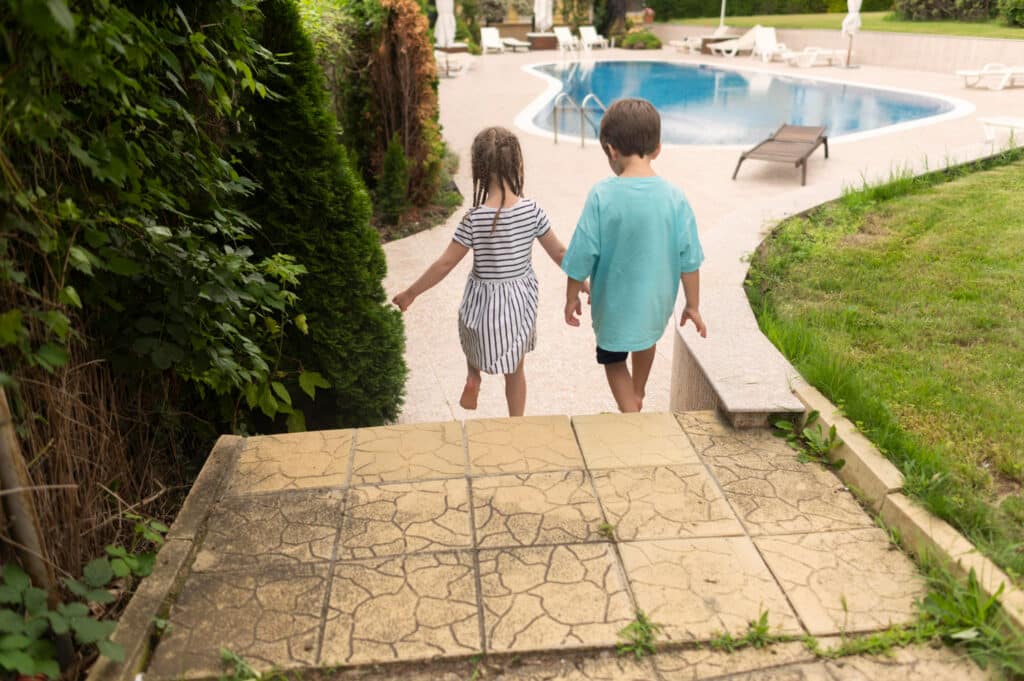
It’s easy to get swept up in colour palettes and layout patterns when you’re browsing pool paving ideas. But there’s a question that should come first: how safe is this surface when it’s wet?
Around a pool, surfaces are constantly splashed. Kids run. Adults step out of the water onto the paving with wet feet. Australian Standard AS 4586 is the national benchmark for classifying slip resistance in pedestrian surfaces. It uses a wet pendulum test to assign P ratings-the higher the number, the grippier the surface when wet. The companion guidance document SA HB 198 recommends a minimum P4 rating for pool surrounds. Meanwhile, pool ramps and stairs should be rated P5 or higher. There’s also a barefoot ramp classification (A, B, C) specifically for areas where people walk without shoes on wet surfaces-B for pool surrounds, C for entry stairs.
No mandatory Australian regulation currently prescribes a specific P rating for residential pool surrounds. But courts and insurers have referenced HB 198 in liability cases, making P4 the practical standard. It’s not something you want to learn about after a slip.
In practice, this means choosing materials with textured, honed or tumbled finishes rather than polished surfaces. It means asking your supplier for slip test certificates. And it means understanding that a paver’s slip resistance can change over time-sealed surfaces, algae buildup and wear all affect grip.
Pool paving ideas (The best materials for Perth)
Not every paving material handles Perth’s combination of heat, UV, salt and sandy soils equally well. Here’s how the most popular pool pavers compare, with honest trade-offs for each.
Concrete pavers
Concrete pavers are the most affordable starting point, with a huge range of colours, textures and sizes. Individual pavers can be lifted and replaced if damaged – a genuine advantage over poured surfaces.
The trade-off? They’re prone to efflorescence (white salt deposits) and colour fading under Perth’s relentless UV. Choosing “coloured-through” pavers helps with fade resistance. They’ll need to be sealed every two to three years. Lifespan: 25–50 years.
Limestone
Limestone is a Perth favourite for good reason. Locally sourced Tamala limestone has one of the lowest thermal conductivity ratings of any common paving stone, meaning it stays noticeably cooler underfoot. Light-coloured varieties perform particularly well, reflecting solar radiation rather than absorbing it.
The catch? Limestone is calcareous-it reacts to acid. Pool chemicals, citrus and certain cleaning products can etch the surface. Around salt chlorinator pools, ongoing salt exposure accelerates wear unless you seal every two to three years (or annually for coping next to the water). Some installers caution homeowners about using limestone coping with salt chlorinator pools unless it is regularly sealed. Lifespan when maintained: 50–100+ years.
Travertine
Travertine is widely considered one of the best natural stone options for pool surrounds. Its porous structure creates tiny air pockets that act as insulation, keeping the surface cooler than denser stones. Tumbled finishes provide excellent wet grip without feeling rough, a combination hard to replicate with other materials.
That porosity is a double-edged sword, though. Travertine absorbs more water than limestone, requiring diligent sealing every one to two years. Like limestone, it’s vulnerable to acid etching and salt damage. Nearly all travertine in Australia is imported, putting it at the higher end of the price range. Lifespan with consistent sealing: 50+ years.
Porcelain pavers
If low maintenance is your priority, porcelain pavers deserve serious consideration. With water absorption often below 0.2%, they’re virtually impervious to moisture damage, staining, mould, algae and efflorescence. Colour pigments fused during high-temperature firing make them essentially fade-proof, which is a major advantage under Perth’s extreme UV.
They don’t require sealing, resist salt chlorinator chemicals, and come in textured finishes that meet slip-resistance requirements. Light-coloured porcelain is also heat-resistant enough for comfortable barefoot use in summer. The main downsides: edges can chip on impact, and installation requires specific adhesive and bedding techniques. Lifespan: 30–50+ years with minimal upkeep.
Exposed aggregate concrete
Exposed aggregate is arguably Perth’s most popular outdoor surface finish. The textured stone surface provides a strong natural grip, and the seamless finish eliminates joints where weeds take hold. You can customise the look through aggregate colour and size.
Worth noting: the rough texture can cause more abrasion in falls, which matters with young children. Damaged sections can’t be spot-repaired like individual pavers. You’d need to cut out and repour. Resealing is required every one to three years for topical sealers, or seven to 10 years for penetrating types. Lifespan before potential resurfacing: 20–30 years.
How your paving choice fits the bigger picture
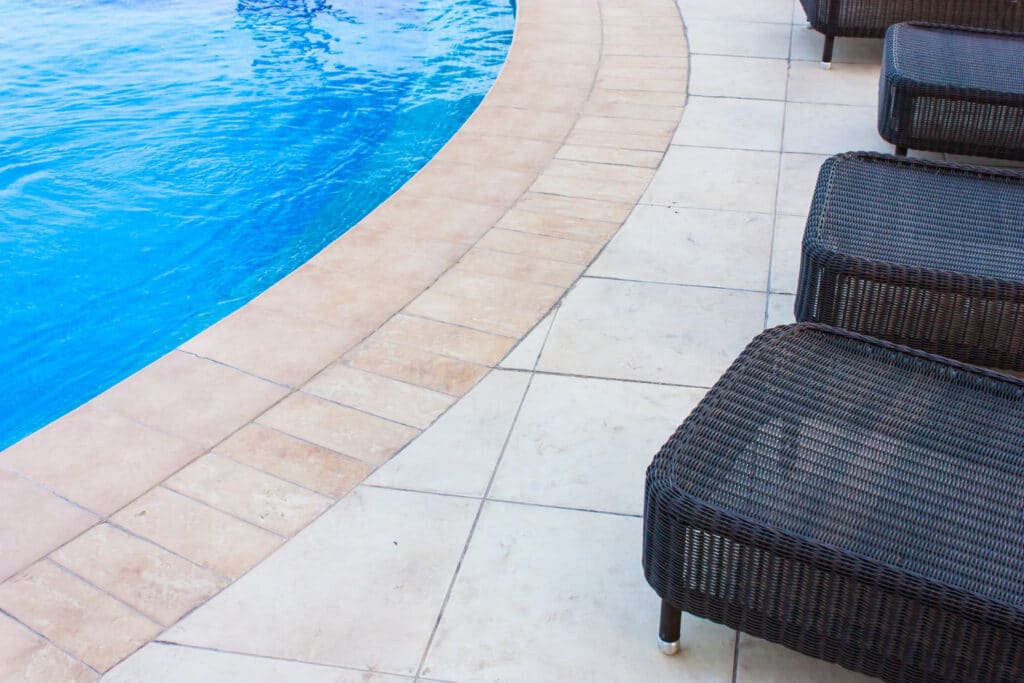
Pool paving doesn’t exist in isolation. The best pool paving ideas consider the full picture: planting, fencing, level changes and the overall flow of your pool landscaping design. A few principles worth keeping in mind:
Colour should connect, not compete
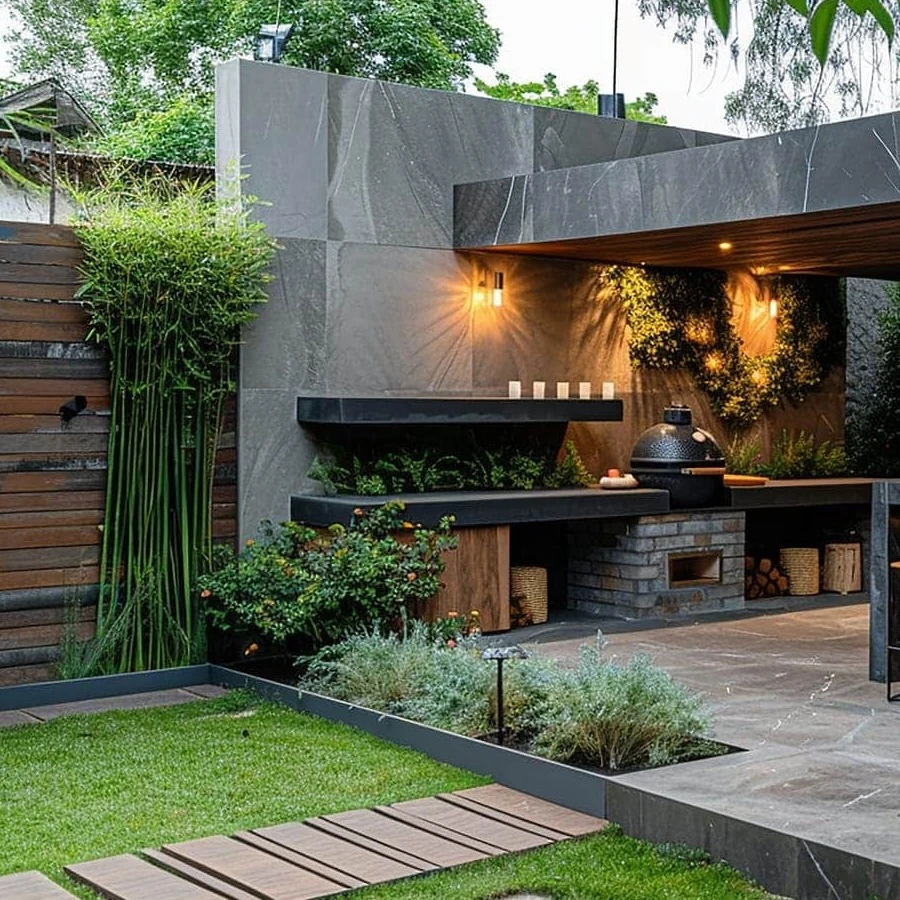
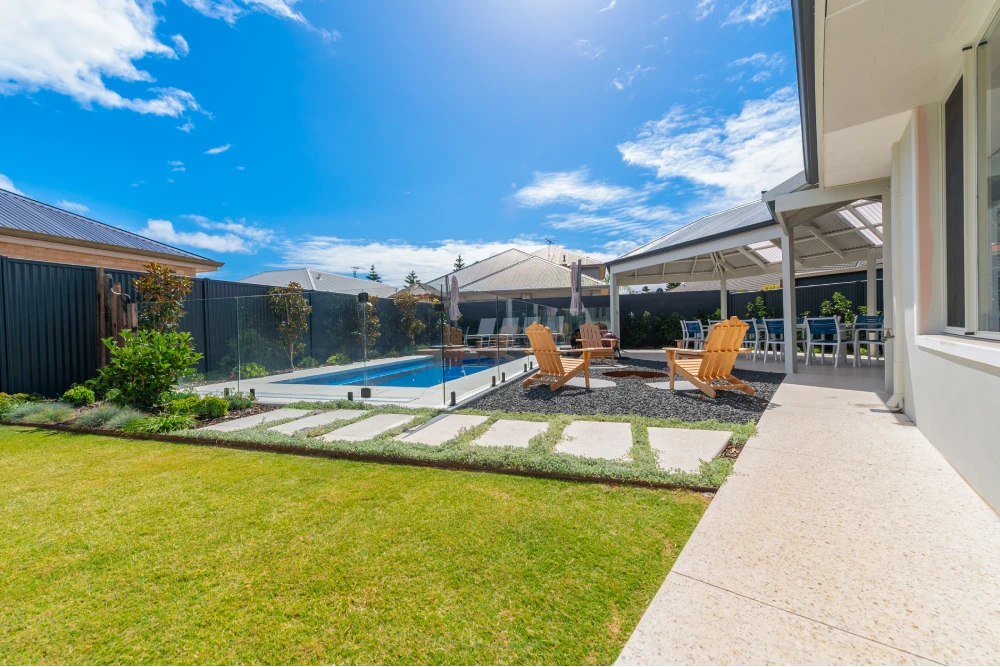
Your paving, coping, fencing and house exterior should share a cohesive palette. Light limestone or travertine pairs naturally with Perth’s sandy coastal tones. Dark charcoal porcelain creates a striking modern contrast, but be mindful of heat if it’s in full sun.
Levels and transitions matter
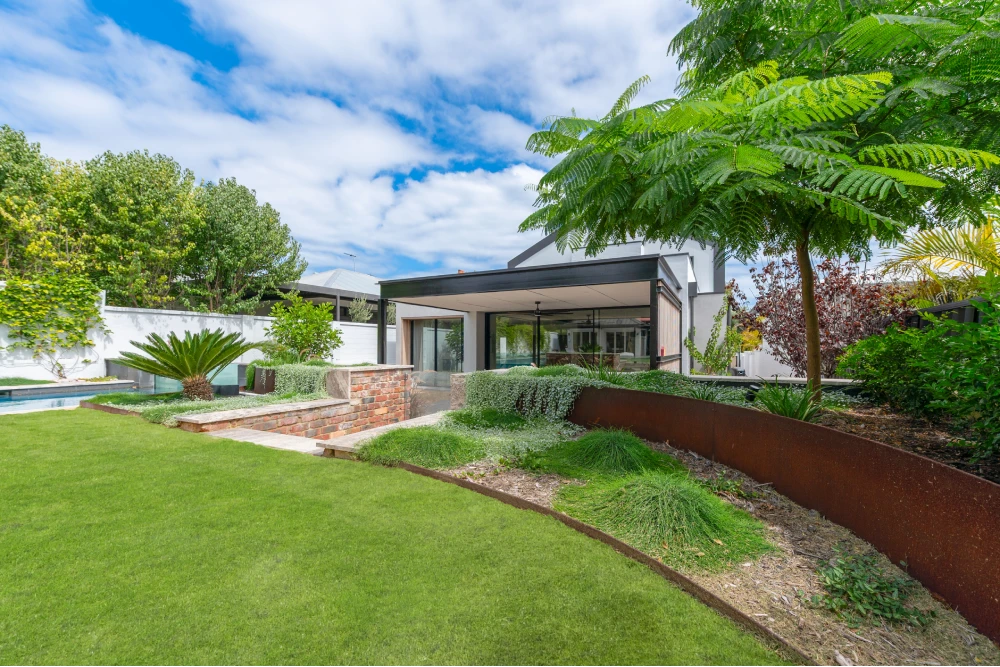
Pool surrounds rarely sit on a single flat plane. Retaining walls, stepped terraces and raised garden beds all intersect with paving, and each level change needs its own drainage consideration and edge restraints.
Planting buffers do real work
Strategic garden beds between pool paving and lawn areas catch runoff, reduce reflected glare, and filter bore water before it reaches the stone-relevant if you’re in a Perth suburb with high iron content in the groundwater.
Fencing integration is non-negotiable
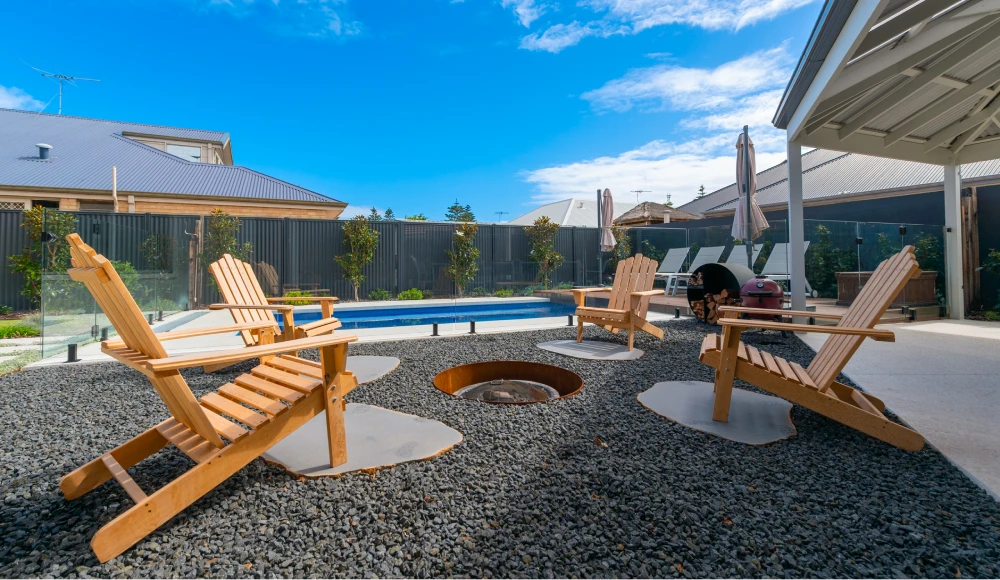
WA’s pool safety barrier requirements mandate compliant fencing around any swimming pool area holding water deeper than 300mm, with penalties of up to $5,000. Your paving layout needs to account for fence post footings, gate clearances and the non-climbable zone under AS 1926.1. Glass pool fencing is popular precisely because it doesn’t obstruct sightlines-but footings need to be planned into the paving from day one.
Drainage, spacing and installation details homeowners overlook
This is where pool paving ideas move from inspiration to execution, and it’s almost entirely invisible once the job is finished.
Getting the fall right
All pool paving must slope away from the pool’s edge at a gradient of 1–2%, directing water towards perimeter drainage channels, garden beds or soakwells. It sounds simple, but achieving a consistent fall across a large paved area requires precise base preparation.
In Perth, property owners have a statutory obligation to confine water runoff within their boundaries. Paved surfaces carry a runoff coefficient of 1.0, meaning 100% of rain becomes runoff. Your pool paving needs an integrated drainage plan, typically involving soakwells sized to your impervious area.
Why expansion joints aren’t optional
Perth’s temperature extremes-surfaces can swing from winter ambient to over 60°C in summer-cause significant expansion and contraction. The pool shell and surrounding paving are independent structures that move at different rates, making the joint between them critical.
A minimum 19mm compressible expansion joint should separate coping from paving, filled with closed-cell foam backer rod and topped with UV-resistant flexible sealant. Within the paving field, control joints should be spaced no more than 3.5–4.5 metres apart. Skip these, and you’ll see cracking within a few summers.
Perth’s sandy soils: Great for drainage, tricky for structure
The Swan Coastal Plain’s sandy soils, from the highly permeable Bassendean Dunes inland to the Spearwood and Quindalup systems near the coast, drain exceptionally well. That’s good news for preventing waterlogging. But sand provides poor lateral support without proper compaction.
A reliable base build involves excavating to depth, mechanically compacting the subgrade, laying compacted crushed limestone or aggregate base, then screeding a bedding layer before pavers are placed. Geotextile fabric between the subgrade and aggregate base prevents fines from migrating upward.
This isn’t a step you can shortcut. Insufficient compaction is the single most common cause of paving settlement in Perth.
What to expect over time: Maintenance and longevity
Even the best pool paving ideas fall flat without a maintenance plan. How your chosen material is cared for-particularly in the first few years-determines whether it still looks good in a decade.
Sealing makes or breaks porous materials
Penetrating sealers (which enter the pore structure without forming a surface film) are preferred around pools because they maintain slip resistance and allow stone to breathe. Topical film-forming sealers can become slippery when wet and yellow under UV. In Perth’s sunshine, sealer degradation happens faster than manufacturers suggest. Plan for the shorter end of the reapplication windows.
Salt chlorinator pools demand extra vigilance
Most swimming pools in Perth run salt chlorinators, operating at 3,000–5,000 ppm salt. These pools produce splash water that leaves salt crystals on porous surfaces as it evaporates. Over time, this causes spalling, surface erosion and delamination, particularly in limestone, travertine and sandstone. If you have a salt pool and porous paving, annual sealing of coping is realistic, not excessive.
Bore water staining is a Perth-specific headache
Many Perth suburbs rely on bore water for irrigation, and it often carries high iron content. When iron-rich water oxidises on paving, it leaves orange-brown stains that household cleaners can’t shift. If your property is in a high-iron area (the Be Groundwater Wise programme can help you check), consider drip irrigation near paved areas, and pre-emptive sealing.
Efflorescence is normal, not a defect
Those white salt deposits on new concrete and natural stone are a byproduct of moisture moving through cementitious materials. They’re most common in the first year and typically reduce over time. Stiff brushing handles most cases; stubborn deposits may need a dilute acid wash. Delaying your first seal by a few months allows early efflorescence to dissipate.
Ready to plan your pool paving?
If you’ve made it this far, you’re clearly thinking carefully about what goes around your pool, and that’s exactly the right approach. The material you choose, how it’s installed and how it connects with the rest of your landscape all shape how your outdoor space performs for years to come.
Here at Luke’s Landscaping, we’ve been designing and building pool surrounds across Perth since 2008. With a team that understands Perth’s sandy soils and UV conditions inside out, we’re built for exactly this kind of project.
Whether you’re building a new pool or upgrading tired surrounds, we can walk you through material options, drainage and layout, tailored to your property and lifestyle. Get a free quote or explore our pool landscaping services and paving projects to see what’s possible.
Frequently asked questions
There’s no single best. It depends on your priorities. Travertine pavers and limestone stay coolest underfoot and suit Perth’s coastal aesthetic, but need regular sealing, especially around salt chlorinator pools. Porcelain pavers are the lowest-maintenance option, resisting stains, fading and salt damage without sealing. Concrete pavers offer the most budget-friendly entry point. The best choice balances your climate exposure, maintenance commitment and design goals.
The guidance document SA HB 198 (companion to Australian Standard AS 4586) recommends a minimum P4 wet pendulum rating for pool surrounds and P5 for stairs or ramps leading into the pool. While not legally mandatory for residential pools, these ratings are referenced in liability cases and insurance assessments, making them the practical benchmark.
The paving itself typically doesn’t require a separate building permit, but the overall pool construction does, and that process covers barriers, drainage and stormwater management that directly affect your paving design. WA pool safety barrier requirements under AS 1926.1 must be met, and your local council will inspect compliance. If your project involves retaining walls over 500mm or attached structures, additional approvals may apply.
Colour is the single biggest factor. Light-coloured materials reflect more solar radiation and stay significantly cooler than dark alternatives, regardless of stone type. Beyond colour, limestone and travertine have lower thermal conductivity than granite or dark concrete, transferring less heat to bare feet. Shade structures, strategic tree planting and outdoor lighting that enables evening use can also extend comfortable pool time during Perth’s hottest months.
It varies by material. Concrete pavers and limestone typically need resealing every two to three years. Travertine requires sealing every one to two years due to higher porosity. Exposed aggregate needs resealing every one to three years for topical sealers or seven to 10 years for penetrating types. Porcelain pavers and granite generally don’t require sealing. Around salt chlorinator pools, coping may need annual attention regardless of material.