The quick version
- Costs for pool decking in Perth vary depending on material choice, the size and shape of your pool surround, site preparation requirements, and Perth’s specific climate conditions.
- Composite and timber decking sit at different points on the cost spectrum, each with different maintenance and compliance profiles.
- Sloped blocks, limited access, and drainage needs can shift costs as much as the decking material itself.
- Timber decking in Perth’s UV conditions may need re-oiling or re-coating every 12 to 24 months to maintain safety compliance, a recurring cost that affects the long-term investment.
- New decking near a pool fence can reduce the barrier’s effective height below the 1200mm minimum required under AS 1926.1, a compliance risk worth checking before construction begins.
- A site-specific assessment is the only reliable way to understand the full scope and investment for your property.
For a large majority of families in Perth, the swimming pool is the centrepiece of the outdoor space. It’s what kids bolt towards bright and early on a Saturday morning and the activity that forces everyone outside on a 35-degree afternoon.
But the decking around it? That’s where a large part of the investment sits and where most of the cost variation happens.
If you’ve been searching for a straight answer on pool decking costs in Perth, you’ve probably noticed the numbers seem to have wide variations and are always changing. This is because two properties on the same street can produce completely different projects, based on materials, site conditions, and, as a result, price points.
What actually drives those differences is a question every aspiring pool owner needs answered. Walk into a design consultation informed and confident about what shapes your pool surround costs in Perth.
What drives pool decking cost variation
Three factors sit at the top of every pool decking project: what you build with, how much of it you need, and what goes around the edges. Each one moves the overall investment in a different direction.
Material choice
The type of decking you choose for your pool surround is typically the single biggest cost variable.
Composite and timber are the two main categories, and they sit at different price points. Composite decking boards are manufactured to consistent specifications, which means their slip resistance can be tested and certified against Australian Standard AS 4586 before they leave the factory. Products with NATA-accredited test certificates simplify the compliance pathway for local council and National Construction Code (NCC) requirements, but they come at a higher upfront material cost.
Timber is a different proposition. Its slip resistance varies depending on the wood species, board profile (smooth, grooved, or reeded), and the finish applied. Smooth, heavily oiled boards can perform poorly in wet conditions, while reeded or rough-sawn profiles grip better underfoot. That variability makes it harder to obtain a formal slip resistance certificate from a supplier, and you may need post-installation non-slip coatings to meet safety standards around the pool. Those additional treatments become part of the overall cost.
The timber vs composite decision involves more than upfront price, too. Durability, maintenance cycles, and expected lifespan under Perth conditions all factor into the long-term picture.
Decking area and layout complexity
The size is straightforward: a larger pool surround means more material and more labour hours. But how the deck wraps around the pool matters just as much as how big it is.
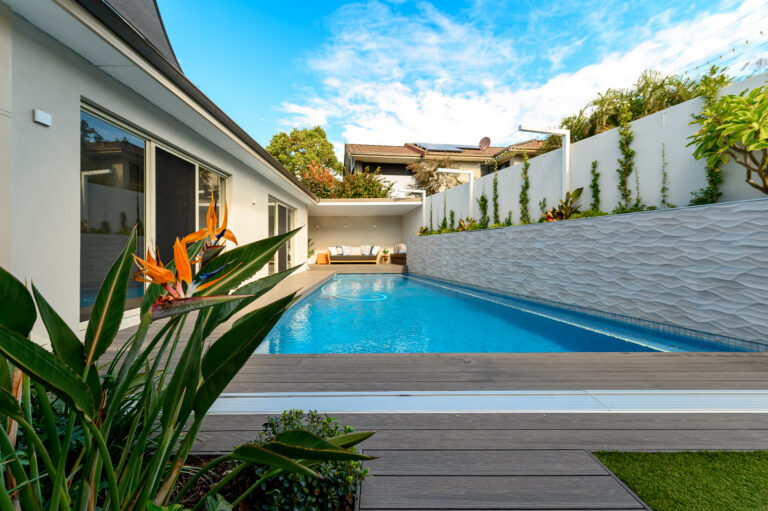
A rectangular plunge pool with straight edges is a simpler build and more cost-effective. Freeform fibreglass pools and custom concrete pools with sweeping curves need intricate sub-frames, hand-cut boards, and custom coping joints to transition smoothly around the shape. That precision work takes longer and generates more material waste.
Larger pool surrounds also require stronger drainage to manage splash-out, swim-out, and Perth’s seasonal downpours. WA councils typically scale stormwater requirements to the total hard-surface catchment area, so a bigger deck costs more for what goes underneath it.
Coping, edging, and non-slip surfaces
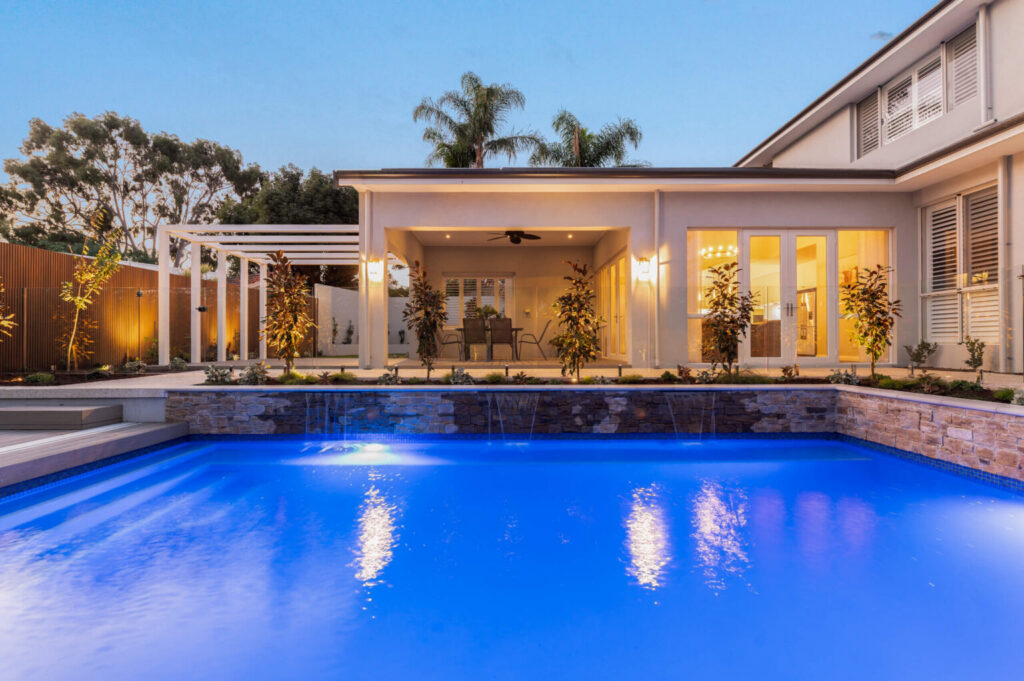
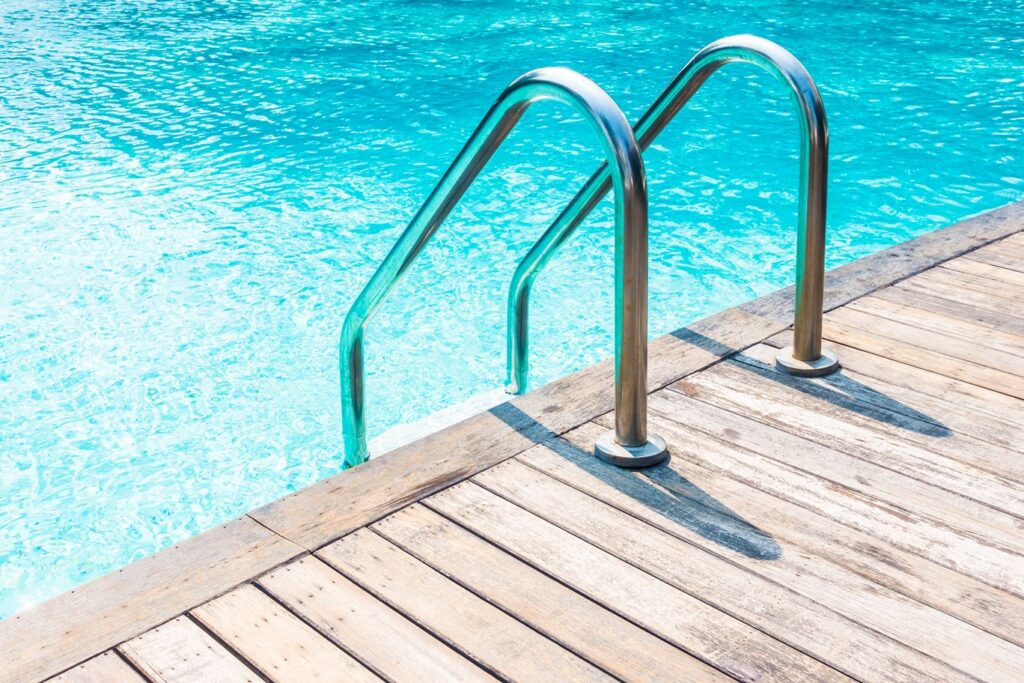
Pool coping is the finished edge between the deck and the pool shell. It might sound like a minor detail, but it plays a structural role. It protects the pool’s beam and provides a safe, rounded handhold for swimmers. The WA Code of Practice for Aquatic Facilities requires pool coping in Perth to be rounded and constructed from non-slip materials.
Material options here range from standard bullnose tile to natural stone to integrated composite edging, each at a different cost point. Non-slip surface treatments, whether factory-applied on composite boards or added post-installation on timber, are an additional line item. Wet pool surrounds typically need materials rated at least P4 or R11 under Australian Standard AS 4586, and meeting that benchmark is essential where bare feet are the norm.
Why every Perth property is different
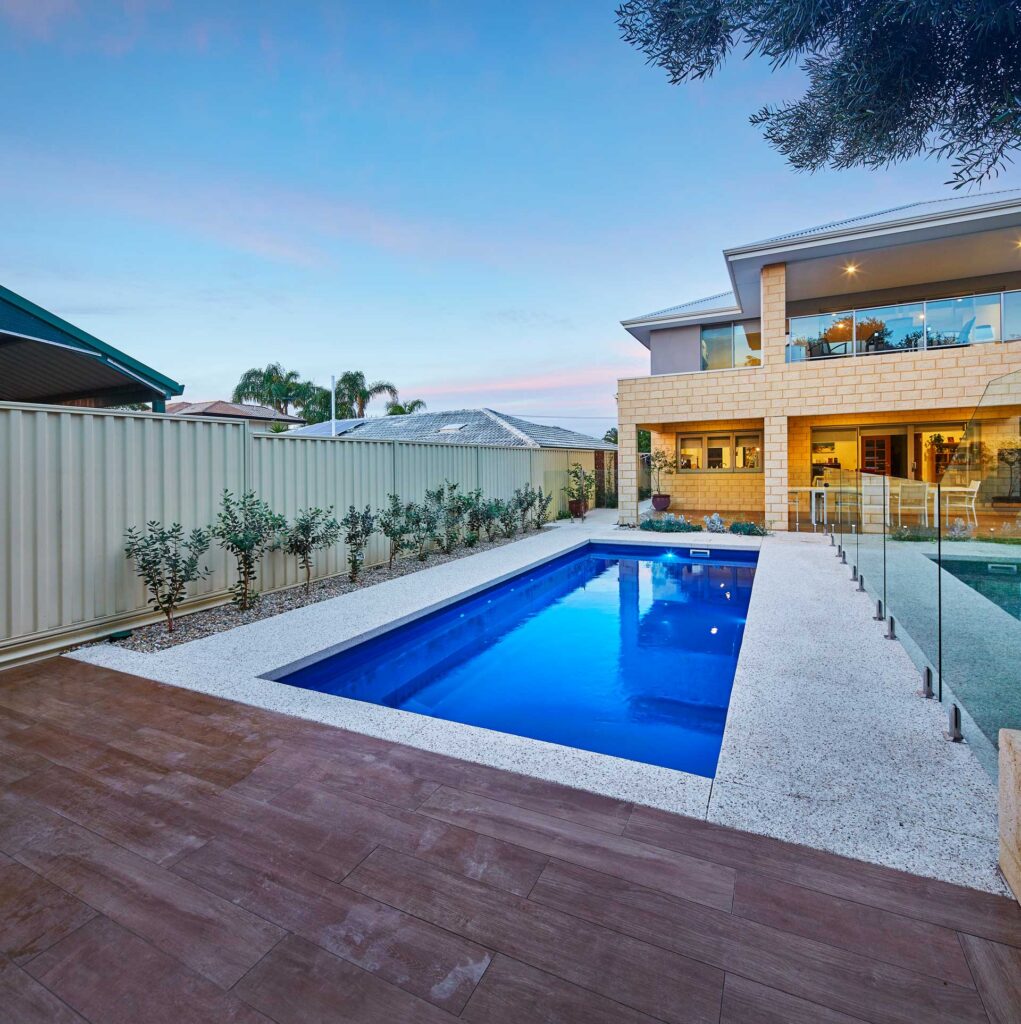
You can control your material choice and your design. What you can’t always control is the block your pool sits on, and that’s often where the biggest project cost surprises come from.
Slope, levels, and retaining walls
Very few Perth blocks are perfectly flat. Managing a slope means earthworks, and depending on how steep the grade is, it may also mean retaining walls to stabilise the ground and protect neighbouring properties.
This gets regulated quickly. If a retaining wall exceeds 500mm in height, councils like the City of Cockburn and the City of Joondalup require formal development approval and structural engineering plans before a building permit is issued. If the deck itself is elevated more than one metre above natural ground level, building codes mandate a structurally engineered safety barrier, which adds engineering, certification, and construction costs to the project.
The legal responsibility for building and maintaining a retaining wall falls on the party who altered the land’s natural slope. That catches more homeowners off guard than almost anything else in a pool project.
Drainage and soil conditions
Pools generate a lot of surface water. Splash-out, swim-out, hosing down the deck, winter downpours. Failing to manage that water properly can cause adjacent paving and structures to crack and settle over time.
Perth’s sandy Swan Coastal Plain generally drains well, which can keep soakwell costs lower compared to other parts of Australia. But the picture changes suburb by suburb. Hitting limestone substrate close to the surface means specialist rock cutting. Clay pockets through the Darling foothills resist infiltration entirely, sometimes requiring pumped discharge systems instead. Proper waterproofing and drainage design beneath the deck prevents long-term damage to adjacent structures.
All drainage work in WA is regulated under the Plumbers Licensing Act 1995 and must be completed by a licensed plumber. That’s a non-negotiable compliance cost regardless of the drainage solution your property needs.
Physical site access
The path from the street to your pool area is an underestimated cost factor in a pool decking project.
Wide side access means machinery can reach the pool edge directly. Excavation, soil removal, and material delivery happen quickly, and that efficiency keeps labour costs down.
Narrow access changes everything. In tighter inner-suburban blocks or renovated cottages where the only way to the backyard is through a single garden gate, heavy precast concrete soakwells can’t physically get in. The builder switches to modular plastic systems that can be hand-carried and assembled on site. All soil, sub-frame timber, and deck boards go in the same way. That multiplies labour hours significantly.
How Perth’s climate shapes your material options
Perth’s environment is stunning, but it is not gentle on building materials. The climate directly affects which products are suitable for pool surrounds and what they cost to maintain over the life of the deck.
UV exposure
Perth receives exceptional levels of UV radiation, and pool water amplifies the effect by reflecting UV onto surrounding surfaces. This has two cost implications.
First, UV light degrades surface finishes on decking materials over time. Timber decking is particularly affected. The oils, sealers, and non-slip coatings that maintain safety compliance break down faster under Perth’s intense sun, creating a recurring maintenance cost that is typically every 12 to 24 months to keep the deck safe and presentable.
Second, surface temperature matters around a pool more than almost anywhere else. Dark-coloured surfaces absorb significantly more solar heat than lighter alternatives, and urban heat research confirms that material colour and composition have a substantial effect on how hot a surface becomes underfoot. Choosing lighter-coloured decking isn’t just about aesthetics. It directly affects whether the pool area is actually comfortable to use on a hot day.
Coastal salt air
A significant portion of Perth’s metro area stretches along coastal dune systems. In beachside suburbs, salt-laden soils and groundwater create a corrosive microclimate that is particularly aggressive on metallic fixings and fasteners. Combine that with splash from increasingly popular saltwater pool systems, and standard hardware corrodes far faster than it would inland.
Marine-grade stainless steel or aluminium sub-frames and fixings cost more upfront, but they prevent premature structural failure in coastal environments. It’s a case where spending more at the start saves significantly more over time.
Bushfire-prone areas
Properties along the Darling Scarp and near coastal bushland may sit within a designated Bushfire Prone Area. In those zones, any new deck is classified as an associated residential structure under the National Construction Code and must comply with Bushfire Attack Level (BAL) standards. That restricts which materials can be used, mandates specific construction methods, and can increase the overall cost of a pool decking project compared to an equivalent build in a lower-risk suburb.
Why a site-specific conversation is the only way to know
By now, you can see why a single headline figure for pool decking costs in Perth doesn’t hold up. Every combination of material, pool shape, soil profile, slope, access, and climate exposure produces a different project with a different investment.
An established Perth landscaper will assess your block, your pool, your soil, and your specific compliance requirements before any figures are put on paper. It’s the only way to understand the full scope of what your project needs, and what it will cost, before work begins.
Talk to Luke’s Landscaping about your pool surround
At Luke’s Landscaping, we’ve been designing and building pool landscaping across Perth since 2008. Our team brings genuine local expertise to every project: from sandy coastal blocks along Rockingham and City Beach to the sloped foothills properties that need careful engineering.
We handle everything from initial design consultation through to construction and regular maintenance, so you’re not left coordinating multiple trades yourself.
If you’re starting to think seriously about your pool area, get in touch to talk through your project.
Frequently asked questions
In many cases, yes. If the existing slab is structurally sound, level, and draining correctly, composite or timber decking can be installed over the top using adjustable pedestal systems or battened sub-frames. This can reduce demolition and waste removal costs compared to ripping out the old surface and starting from scratch. However, the finished deck height needs to be checked against your pool barrier compliance, because raising the ground level next to the fence can reduce its effective height and trigger a compliance issue. A site inspection will confirm if your existing slab is a viable base.
It can. Under AS 1926.1, a pool barrier must maintain a minimum effective height of 1200mm, measured from the finished ground level on the outside of the fence. If new decking raises the surface level next to the barrier, even by the depth of a sub-frame and boards, the effective fence height drops. That can push a previously compliant barrier below the minimum and trigger a failed pool inspection. It’s something your landscaper and pool fence installer need to coordinate before construction begins, not after.
It can. Saltwater chlorinators are increasingly popular in Perth, and the salt-laden splash that lands on the deck and sub-frame is more corrosive than freshwater chlorine over time. Metallic fixings and fasteners are the most vulnerable components. If you have a saltwater system, your installer should be specifying marine-grade stainless steel or coated fasteners as standard, not as an optional upgrade. The decking boards themselves are generally unaffected, but the hardware holding them together needs to match the environment.
It depends on the scope, but most residential pool surrounds in Perth take between two and four weeks from site preparation to completion. Simpler rectangular layouts on flat, accessible blocks sit at the shorter end. Projects involving slopes, retaining, custom shapes, or restricted access take longer because of the additional earthworks, engineering, and hand-labour involved. Weather can also play a role, particularly if earthworks are underway during Perth’s wetter winter months.
The most reliable path is a site-specific assessment where a landscaper evaluates your block, pool shape, soil, access, and drainage requirements in person. Online cost ranges can give a general sense of scale, but they cannot account for the variables that are unique to your property. A detailed conversation about your specific site is always the best starting point.